





 Wednesday, 03-06-26








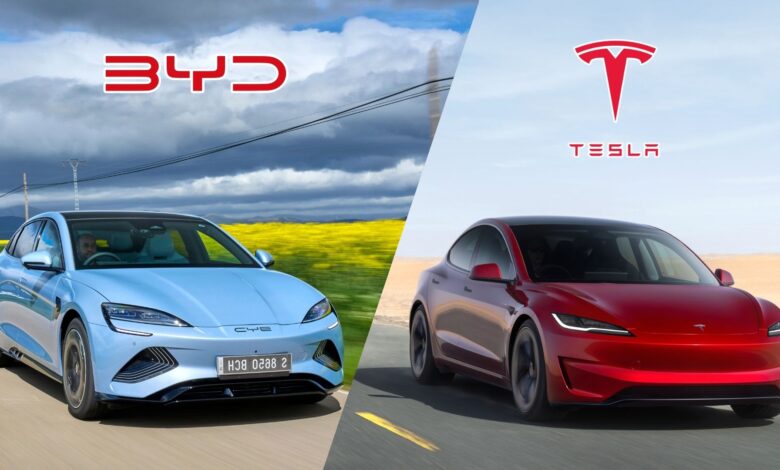
In the rapidly evolving global electric vehicle industry, one narrative has grown increasingly prominent: BYD Global EV Sales are projected to surpass those of Tesla by the end of 2025. Once primarily recognized as China’s domestic EV powerhouse, BYD Co. Ltd. has executed a strategic expansion that has captured the attention of analysts, investors, and automotive stakeholders worldwide. This shift not only signals changing competitive dynamics in the electric vehicle (EV) market but also underscores deeper transformations in consumer demand, product strategy, and global commerce.
The Asia Business Outlook report highlights that BYD is on track to outpace Tesla’s total EV deliveries in 2025. Industry estimates indicate BYD has already sold approximately 2.1 million units of electric vehicles—including both pure battery electric vehicles (BEVs) and plug-in hybrid electric vehicles (PHEVs)—while Tesla’s global sales for the year are forecasted at around 1.7 million units. Asia
Understanding the drivers behind this shift requires an examination of the unique approaches and market strategies employed by both companies. For BYD, a blend of product diversity, pricing strategy, and global expansion is reshaping its competitive edge. For Tesla, longstanding brand recognition and BEV leadership persist, but slowing sales in major markets are creating new challenges.
In this article, we will explore the strategic factors driving BYD Global EV Sales, how they compare with Tesla’s market performance, and what this means for the future of the global EV industry.
Market Dynamics Behind BYD’s Growth
When analyzing BYD Global EV Sales, a foundational consideration is product segmentation. Unlike Tesla, which focuses exclusively on BEVs, BYD’s broader portfolio includes both BEVs and PHEVs. This product diversity has widened its appeal across different consumer segments and regulatory environments where hybrid vehicles remain in demand. According to the Asia Business Outlook report, the majority of BYD’s current sales growth is being driven by strong demand for plug-in hybrid models. This diversified lineup has enabled BYD to capture a greater share of global market demand, particularly in regions where full electrification infrastructure may still be developing. PHEVs offer an attractive bridge for consumers who seek reduced emissions and improved fuel efficiency but are not yet ready to commit fully to BEV ownership due to concerns about charging infrastructure or range anxiety.
In contrast, Tesla’s singular focus on BEVs has been a defining element of its strategy and brand identity. However, this focus also limits its addressable market in regions where hybrid options remain attractive to buyers. For instance, in many parts of Asia, Europe, and Latin America, consumers have shown strong interest in PHEVs as transitional vehicles that combine electric driving with conventional range capability.
In addition to product mix, BYD has invested heavily in cost management and vertical integration. The company manufactures key components in-house—including batteries through its Blade Battery technology—allowing it to control costs, improve margins, and maintain competitive pricing even as raw material costs fluctuate. Such integration has contributed to accelerated production scales and improved operational efficiency, factors that support rising BYD Global EV Sales.
Global expansion is another pillar of BYD’s strategy. The company has developed a production footprint outside China, with facilities in Hungary and other strategic locations, enabling it to mitigate tariff barriers and better serve local markets. By establishing manufacturing closer to key demand centers, BYD can respond more swiftly to market needs while reducing logistics costs.
Comparative Performance: BYD Versus Tesla
To understand the significance of BYD Global EV Sales overtaking Tesla, it is essential to compare performance trajectories. Multiple independent data sources indicate that BYD has consistently increased its EV deliveries year-over-year, driven by both domestic demand and international expansion. A benchmark performance through the first three quarters of 2025 shows BYD delivering significantly more BEVs than Tesla. Industry data suggests BYD sold more than 1.6 million BEVs from January through September 2025, compared to Tesla’s approximately 1.22 million.
This performance reflects a sustained competitive advantage. BYD’s rise is not limited to unit sales; its revenue performance also highlights its growth trajectory. For example, in 2024, BYD reported sales exceeding $100 billion in revenue, surpassing Tesla’s 2024 revenue of approximately $97.7 billion. The combination of robust sales growth and strong financial performance reinforces BYD’s emergence as a major global automotive player.
Tesla, for its part, continues to lead in certain areas. The brand remains dominant in North America and has cultivated a strong identity around technological innovation, autonomous driving development, and consumer enthusiasm. Tesla’s ability to deliver high-performance BEVs has resonated with many EV buyers and helped expand the overall EV market.
However, Tesla is also facing headwinds. Declining EV tax incentives in key markets, such as the expiration of the US federal EV tax credit—has dampened demand in North America. Combined with rising competition from Chinese manufacturers like BYD, Tesla’s growth momentum has moderated. Forecasts from research firms FactSet and Deutsche Bank indicate that Tesla’s deliveries in the fourth quarter of 2025 are likely to ease further due to slower demand across major markets.
Another pressure point for Tesla relates to pricing. While premium positioning has been a competitive strength, BYD’s ability to offer highly competitive pricing through cost leadership has attracted price-sensitive buyers globally. In markets where affordability remains a key purchasing criterion, BYD’s pricing strategy has helped expand its customer base rapidly.
What This Means for the Future of the EV Market
The ascent of BYD Global EV Sales has broader implications for the electric vehicle industry at large. First, it underscores the growing globalization of EV competition. No longer is the EV market dominated by a single American brand; instead, competition is increasingly multipolar, with significant contributions from Asia, particularly China. BYD’s rise demonstrates that technological capability and production scale, combined with strategic market entry, can challenge established players at the highest levels.
Second, the shift highlights the importance of product diversity in the EV sector. Manufacturers that offer a mix of BEVs, PHEVs, and advanced mobility solutions may be better positioned to adapt to varying consumer preferences and regulatory environments. BYD’s success across both EV and hybrid categories suggests that a diversified product portfolio can drive broader market penetration.
Third, BYD’s growth challenges traditional assumptions about where innovation and leadership in EVs originate. While Tesla remains a significant innovator in battery technology and autonomous driving systems, BYD’s vertical integration and manufacturing scale have proven equally powerful in reshaping competitive dynamics. This may encourage other global automakers to reassess their strategic priorities, particularly as emerging markets continue to embrace electrification.
Looking forward, the EV industry is likely to see continued fragmentation and competition. Established European and Asian brands will increasingly vie for market share, leveraging local strengths and strategic partnerships. At the same time, consumer demand for affordability, range flexibility, and technological integration will shape product development.
Ultimately, the projected overtaking of Tesla by BYD in global EV sales is more than a statistical milestone. It signifies a larger evolution in automotive strategy, where market leadership is determined by a combination of production capacity, product diversity, pricing strategy, and geographic reach.
As BYD continues to expand its production footprint and refine its technological offerings, it is well positioned to sustain momentum through 2026 and beyond. Meanwhile, Tesla’s focus on innovation and market differentiation will remain central to its long-term strategy. The competition between these two companies is poised to drive further innovation, broaden consumer choice, and accelerate the global transition to electric mobility.
Read More