





 Sunday, 28-06-26








Urgency of Flood Disaster Insurance in Indonesia
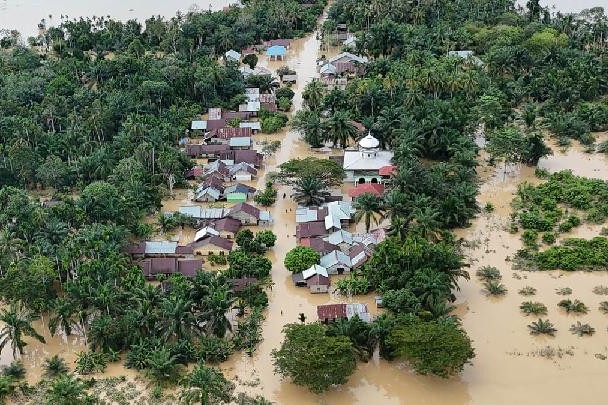
The devastating floods in Sumatra at the end of November 2025 have underscored Indonesia’s vulnerability to natural disasters. According to the National Disaster Management Agency (BNPB), as of December 3, 2025, the floods had killed 753 people, left 650 missing, and affected 3.3 million residents across 50 districts in Aceh, North Sumatra, and West Sumatra.
Bhima Yudhistira, Executive Director of the Center of Economic Law Studies (CELIOS), warned that “total losses from the Sumatra floods are projected to reach IDR 6.28 trillion,” highlighting the growing economic toll of repeated disasters. The scale of destruction suggests that Indonesia’s conventional emergency response mechanisms are no longer sufficient, with government budgets often unable to cover full rehabilitation or reconstruction.
Low Awareness of Insurance as Financial Protection
Despite the financial risks, insurance penetration in Indonesia remains under 3%. Experts note that many citizens still perceive insurance as an unnecessary expense rather than a protective measure.
Budi Herawan, Chairman of the Indonesian General Insurance Association (AAUI), said, “The repeated occurrence of natural disasters shows the urgent need for flood insurance for communities, businesses, and government assets. Risk can be transferred through insurance and reinsurance, allowing faster post-disaster recovery and reducing economic impact.”
Low awareness is particularly evident among homeowners and small businesses in flood-prone areas, while most insurance coverage currently exists for commercial, industrial, and banking-related assets.
Types of Insurance for Flood Risk
Experts emphasize that multiple forms of insurance can mitigate financial losses from floods. These include:
- Property Insurance – Covers damage to homes, offices, and commercial properties caused by floods and other natural disasters.
- Vehicle Insurance – Provides protection against flood damage to personal or commercial vehicles.
- Health Insurance – Ensures medical expenses are covered for injuries or illnesses caused by disaster conditions.
- Life Insurance – Protects families financially in the event of death caused by natural disasters.
OJK has advised policyholders to carefully review coverage details and understand claims procedures, while insurance companies are encouraged to simplify claims post-disaster to facilitate timely recovery.
Government Steps Toward Mandatory Flood Insurance
The Ministry of Finance recently launched a pilot Pooling Fund Disaster Insurance program for state-owned assets, covering education buildings under the Ministry of Religious Affairs, healthcare facilities under the Ministry of Health, and government offices coordinated with the Ministry of Administrative and Bureaucratic Reform.
This initiative represents the government’s commitment to transfer disaster risks to the insurance sector. OJK’s 2023–2027 roadmap includes mandatory disaster insurance as a strategic program, paving the way for nationwide implementation. Environmental economist Emil Salim emphasized, “Collaboration between government policy and private industry is key to addressing climate change impacts, including floods.”
Experts also suggest integrating insurance obligations into building permits or housing certificates to ensure coverage in flood-prone zones.
Industry Readiness and Risk Management
The insurance industry has begun preparing for potential claim surges. Budi Herawan of AAUI explained that companies are leveraging reinsurance mechanisms, technical reserves, and diversified underwriting strategies to absorb disaster risks.
“Reinsurance mechanisms act as the primary buffer when claims surge due to natural disasters,” Budi said, highlighting that reinsurance acts as the first layer of protection during major flood events.
AAUI is coordinating with member companies to collect and consolidate initial claims from recent floods in Sumatra. While household and small business coverage remains limited, most claims are expected from commercial, industrial, infrastructure, hotel, and bank-financed properties. Budi also stressed that all insurers are encouraged to process claims quickly, transparently, and fairly according to policy agreements.
This article is based on three original reports from CNBC Indonesia, Bisnis.com, and AAUI, titled "Urgensi Asuransi Wajib Bencana (Banjir)", published on 05 December 2025; "Simak! Ini 4 Jenis Asuransi Cegah Kerugian Finansial Akibat Bencana Alam", published on 07 January 2024; and "AAUI: Asuransi Siap Hadapi Lonjakan Klaim Banjir 2025", published on 08 December 2025.
PHOTO: ANTARA/SYIFA YULINNAS
This article was created with AI assistance.
Read More