





 Tuesday, 15-09-26








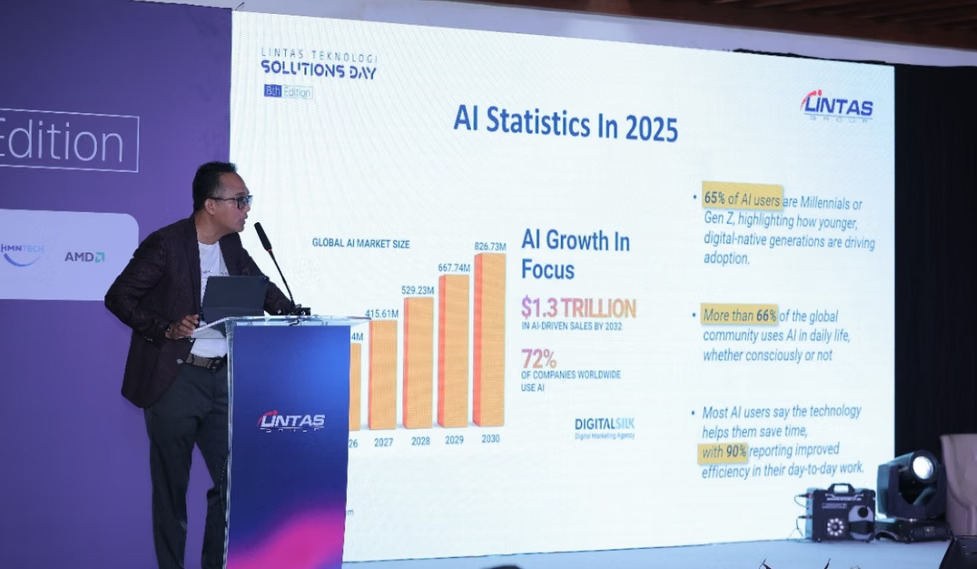
As companies across Indonesia and beyond rush to adopt artificial intelligence (AI), many find that the financial benefits remain elusive. Recently published data suggests that a majority of firms adopting AI have not yet realized meaningful returns on investment (ROI). This persistent shortfall has begun to erode investor confidence, with many now reluctant to deploy fresh capital. The situation highlights a critical phase in the broader AI transformation between early adoption hype and sustainable financial performance.
The Reality Check on AI Adoption
While adoption rates for AI technologies continue to rise, actual returns remain uneven. For instance, a global survey by a leading consultancy found that although a large share of investors urged companies to adopt AI broadly, they also expected clear improvements in productivity, revenue, and profitability within 12 months.
Yet, findings in Indonesia reflect a more cautious story. A study of large companies in the country showed only a small fraction are truly AI ready: just 19 percent of surveyed firms had the infrastructure, computing capacity, and data security systems adequate for leveraging AI effectively. Among those who did implement AI, more than a quarter of respondents admitted they saw little to no benefit in terms of automation, efficiency, or cost savings.
Similarly, while some companies, notably among agile, open source friendly businesses, have reported positive returns on AI investments, such cases remain the minority. For many others, especially larger, more traditional firms, AI remains more of a cost center than a profit driver, at least for now.
Why Many AI Adopters Fail to Generate Returns
Several structural and execution level factors contribute to this disconnect between adoption and ROI.
Infrastructure and Readiness Gaps
AI implementation demands significant infrastructure, powerful computing, robust data storage, reliable networks, and strong cybersecurity. In Indonesia, a recent readiness index revealed extensive gaps: many firms lack GPUs, modern data pipelines, or data governance frameworks necessary to support AI workloads. Without these underpinnings, AI deployments often remain limited to pilot projects or show little performance improvement, undermining potential returns.
Skill Shortages and Organizational Inertia
Even when companies invest in technology, human capital remains a bottleneck. Effective AI deployment requires not just engineers or data scientists, but also managers with strategic vision, staff trained to integrate AI into business workflows, and culture receptive to data driven decision making. Many firms struggle along one or more of these dimensions, limiting the effectiveness of their AI initiatives.
Basic Use Cases, Limited Innovation
Evidence suggests that most organizations in Indonesia employing AI focus on basic tasks such as automation, data processing, and operational efficiency, rather than leveraging AI for innovation, new product development, or strategic advantage. Such basic use cases often yield only incremental benefits, insufficient to cover the initial and ongoing costs of AI deployment. Without deep integration into business models, AI remains a support tool, not a growth engine.
Misaligned Expectations and Short Time Horizons
Many investors and company leaders expect quick wins in the form of higher revenue, cost savings, or efficiency boosts within a year or two of AI adoption. However, AI transformation often requires more time, experimentation, learning, and iteration before meaningful returns arise. Unrealistic expectations therefore frequently lead to disappointment.
Impact on Investor Sentiment and Funding Flows
The lack of consistent ROI has begun to sway investor sentiment. While a significant portion of global investors surveyed remain optimistic about AI’s long term potential, their immediate demands center on demonstrable productivity, profitability, and clarity in business model adaptation.
In Indonesia, this skepticism may translate into fewer new investments flowing into AI initiatives, especially in firms that lack the infrastructure or capacity to scale AI effectively. As investors reassess risk versus reward, companies may find it increasingly difficult to secure fresh funding, slowing down adoption momentum and deep integration of AI across the economy.
This dynamic risks entrenching a two tier system: startups and younger companies with flexibility, innovation mindset, and lower legacy burden which may still attract capital, while larger, traditional firms with heavy legacy infrastructure see slow adoption and limited investment interest.
What Needs to Change for AI Investment to Pay Off
To reverse the trend and make AI investment financially viable, companies, together with investors and policymakers, need to focus on several critical areas.
- Build proper infrastructure before wide deployment. That means investing in computing power, data storage, security, network reliability, and monitoring systems, the technical foundation without which AI cannot deliver.
- Develop human capital and organizational readiness. Beyond hiring data scientists, companies must invest in training, change management, and leadership that embraces data driven decision making.
- Shift from efficiency focused use cases to strategic, innovation led AI. Instead of merely automating existing tasks, firms should explore ways AI can enable new products, services, business models, or customer experiences that deliver disproportionate returns.
- Adopt realistic timelines and manage investor expectations. AI transformation is not an instant productivity magic wand. It requires experimentation, iterations, failures, learning, and incremental improvements before delivering substantial returns.
- Leverage open source tools and ecosystems where possible. Some companies in Indonesia already find better ROI outcomes by using open source AI solutions combined with hybrid cloud or on premises infrastructure, reducing licensing costs and increasing flexibility.
Conclusion: AI Investment Challenge Is Real but Not Insurmountable
The promise of AI remains compelling. For Indonesia, with its large economy, demographics, and ambition to digitalize, successful AI adoption could unlock productivity gains, new services, and competitive advantage. But the recent reality shows that adoption alone does not guarantee returns.
The AI Investment Challenge, the gap between AI adoption and actual ROI, has emerged as a bottleneck, influencing investor sentiment and slowing capital inflow. For AI to fulfill its potential, companies must treat AI not as a one off project, but as a long term transformation journey encompassing infrastructure, people, strategy, and realistic expectations.
With the right foundation, clear vision, and patient investment, AI could still deliver substantial value, but only if firms and investors alike acknowledge the complexity and commit to a thoughtful, long term approach.
Read More