





 Thursday, 15-10-26








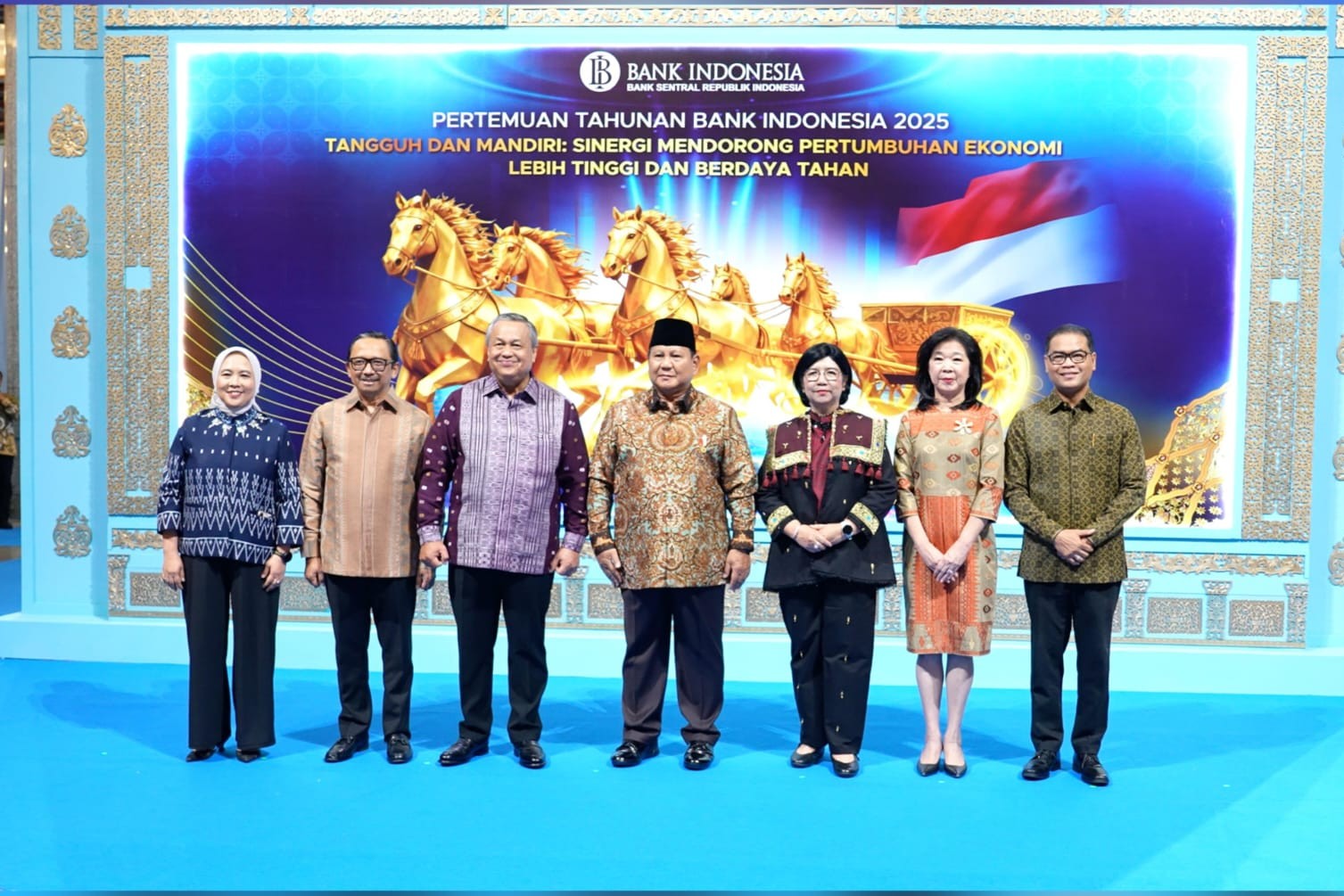
Indonesia maintained solid economic resilience throughout 2025 despite global economic and geopolitical turmoil (28/11).
The achievement was attributed to national collaboration and synergy between fiscal and monetary policies, which ensured both growth and stability.
President Prabowo Subianto highlighted the importance of self-reliance and cooperation, “We must believe in our own strengths and not depend on other countries. We must complement each other and help each other because now is the time to provide quick solutions for the community.”
Bank Indonesia Forecasts Optimistic Economic Outlook
Governor Perry Warjiyo projected Indonesia’s GDP growth for 2025 at 4.7–5.5%, rising to 4.9–5.7% in 2026 and 5.1–5.9% in 2027.
Growth is expected to be supported by increasing consumption, investment, and steady export performance, even amid global economic moderation. Inflation is projected to stay within the target corridor of 2.5%±1% in 2026 and 2027, backed by consistent monetary policy, fiscal synergy, and stronger implementation of the National Food Security Program.
Bank Indonesia also noted five ongoing global challenges requiring vigilance: US reciprocal tariffs, global economic moderation, high government debt and interest rates in advanced economies, vulnerabilities in the international financial system, and rapid development of private-sector cryptocurrencies and stablecoins.
Policy Synergy to Accelerate Resilient Growth
Bank Indonesia emphasized that policy synergy is essential for faster and more resilient growth.
Five critical areas require focus: macroeconomic and financial stability, acceleration of resilient growth, enhanced financial markets and economic financing, national economic and financial digitalisation, and strengthened bilateral and regional cooperation.
Real sector transformation policies aim to boost capital, labor, and productivity. Industrial policy prioritizes value-added production in sectors such as downstream natural resources, technology, and labor-intensive industries.
Structural policy supports a conducive investment climate, infrastructure connectivity, healthy competition, trade and investment policies, and special economic zones (KEK) as growth hubs.
Monetary and Macroprudential Policy Focused on Growth and Stability
In 2026, Bank Indonesia will continue a policy mix designed to promote economic growth while maintaining stability.
Monetary policy will remain pro-stability while allowing room for pro-growth measures.
Macroprudential and payment system policies will prioritize economic financing and the development of money and foreign exchange markets, following the Money Market Development Blueprint (BPPU) 2030.
Economic and financial inclusion will be strengthened, including support for MSMEs, the sharia economy, and broader digital financial services, ensuring the policy mix contributes to sustainable growth.
Institutional Transformation and Digitalisation at Bank Indonesia
Bank Indonesia is advancing its institutional transformation through three main pillars: strengthening organizational functions and work processes, accelerating digitalisation through the Integrated Digital Central Banking (IDCB) framework, and enhancing human resources via leadership development and capability building.
In 2025, Bank Indonesia received 10 international awards, enhancing its reputation as a leading central bank in Emerging Markets and Developing Economies (EMDEs).
The Annual Meeting also featured the TPID Award, TP2DD Championship, and BI Award, recognizing regional inflation control teams, digitalisation task forces, and 47 strategic partners supporting national economic and financial development.
PHOTO: BANK INDONESIA
This article was created with AI assistance.
Read More