





 Tuesday, 22-09-26








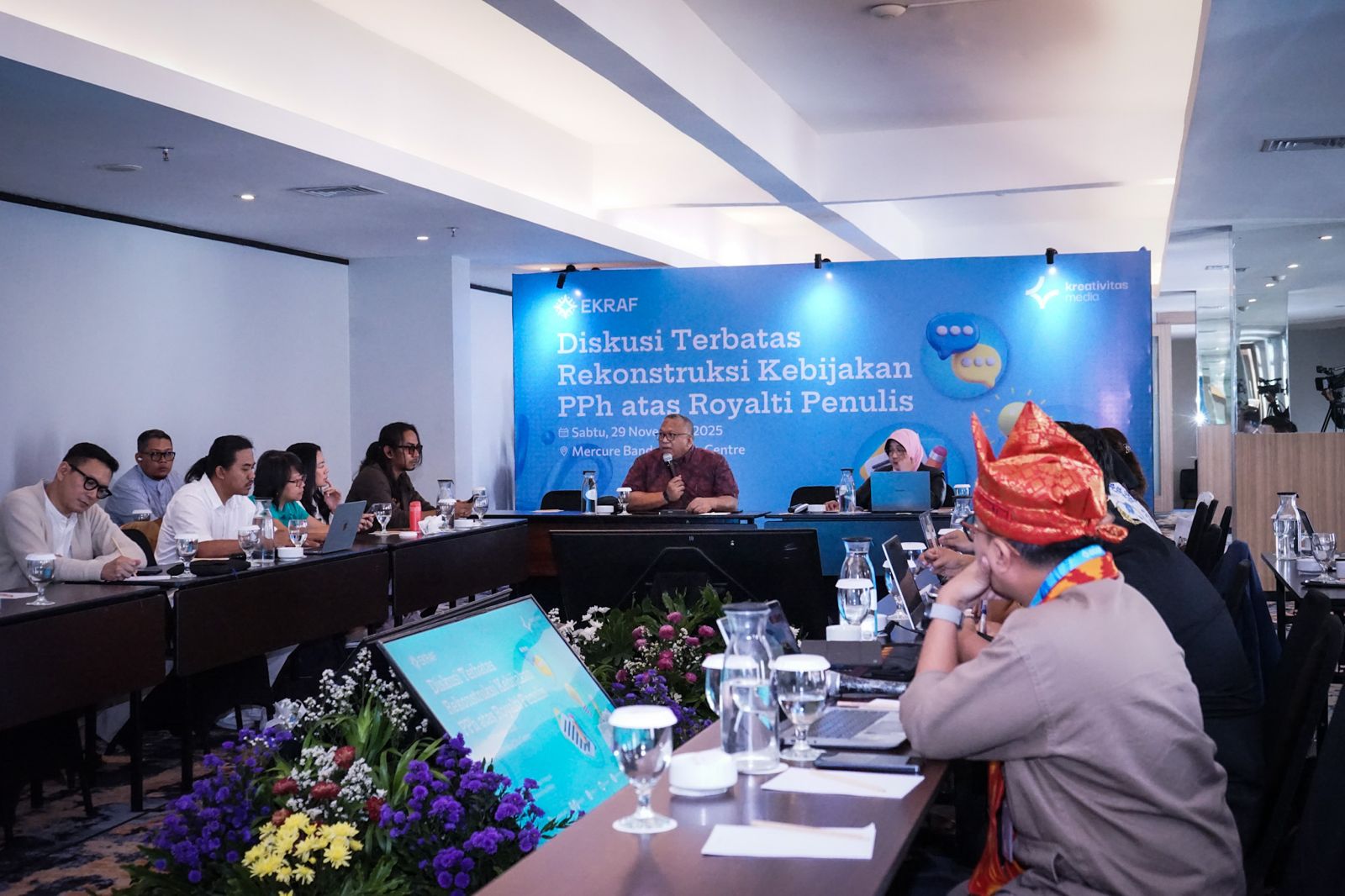
The Ministry of Creative Economy/Badan Ekonomi Kreatif held a Limited Discussion on the Reconstruction of Income Tax (PPh) Policy for Author Royalties in Bandung, West Java, aimed at strengthening the national literacy ecosystem (29/11).
The discussion focused on tax regulations that have long affected writers and the book industry.
Deputy for Media Creativity Agustini Rahayu said the reconstruction effort is an important step in supporting Indonesia’s literacy development.
Writers are the main foundation for the growth of knowledge and culture. Because of that, policies governing them must provide fairness and allow them to develop. And certainly, we want to ensure that tax regulations support creativity, not hinder it. This way, writers can focus on creating works without being burdened by complicated technical processes,” she said online.
Stakeholders Raise Concerns Over Complex Tax Procedures
The discussion brought together writers, publishers, communities, and related ministries and agencies to submit inputs on simplifying the management of income tax on author royalties.
The current policy still presents challenges, especially in the withholding mechanism and administrative requirements for creators.
Under the existing rules, royalty income and freelance earnings are calculated using the Norma Penghitungan Penghasilan Neto (NPPN), which determines net income for individual taxpayers working independently.
Writers often question this mechanism because of its complexity, suitability, and perceived impact on productivity.
Experts Call for Simpler and Fairer Tax Treatment
Professor Dr. Haula Rosdiana, M.Si, from the University of Indonesia, who joined as one of the policy formulators, underlined the positive impact of literacy on society.
“If we are talking about the literacy industry, the principle should be No Tax on Knowledge. This industry generates a very large positive externality, so it deserves tax treatment that is simpler, cheaper, efficient, and not burden authors with heavy administrative responsibilities,” she said during an interview.
Writers Welcome Government’s Continued Efforts
Writer Asma Nadia expressed appreciation for the Ministry’s consistency in supporting discussions on reconstructing the royalty tax policy.
“Seven years have passed since this issue emerged, but only now do we feel the discussion is being conducted with such seriousness and direction. Today is one of many opportunities where we are connected by the Ministry of Creative Economy to push for better tax policies for writers. As a writer, and on behalf of others, we truly feel how challenging it is to survive in this profession. That is why we are very grateful for the government’s efforts toward change,” she said.
The event was attended by long-time literacy industry players, including Asma Nadia, Dee Lestari, J.S. Khaeren, Sunny Gho from the Indonesian Comics Association, Kelir as illustrator representatives, Lentera App as a digital reading platform, Balai Pustaka as publisher, IKAPI, the Presidential Staff Office for Creative Economy, and the Directorate General of Taxes.
Policy Drafting Moves Toward Next Regulatory Phase
Director of Publishing and Photography Iman Santoso stated that the development of the tax policy has entered a significant stage.
He said simplification remains a priority while maintaining fairness and ensuring writers and creative workers are not burdened.
“Our target this year is to complete the academic paper. Next year, the process will continue toward drafting the Government Regulation (RPP). We understand this stage is a major concern for writers, especially regarding the fear of new complexities in implementation. By looking at the ecosystem as a whole, we hope the policy will bring real benefits and improve the welfare of everyone in this subsector,” he said when closing the forum.
PHOTO: MINISTRY OF TOURISM AND CREATIVE ECONOMY
This article was created with AI assistance.
Read More