


 Monday, 19-10-26


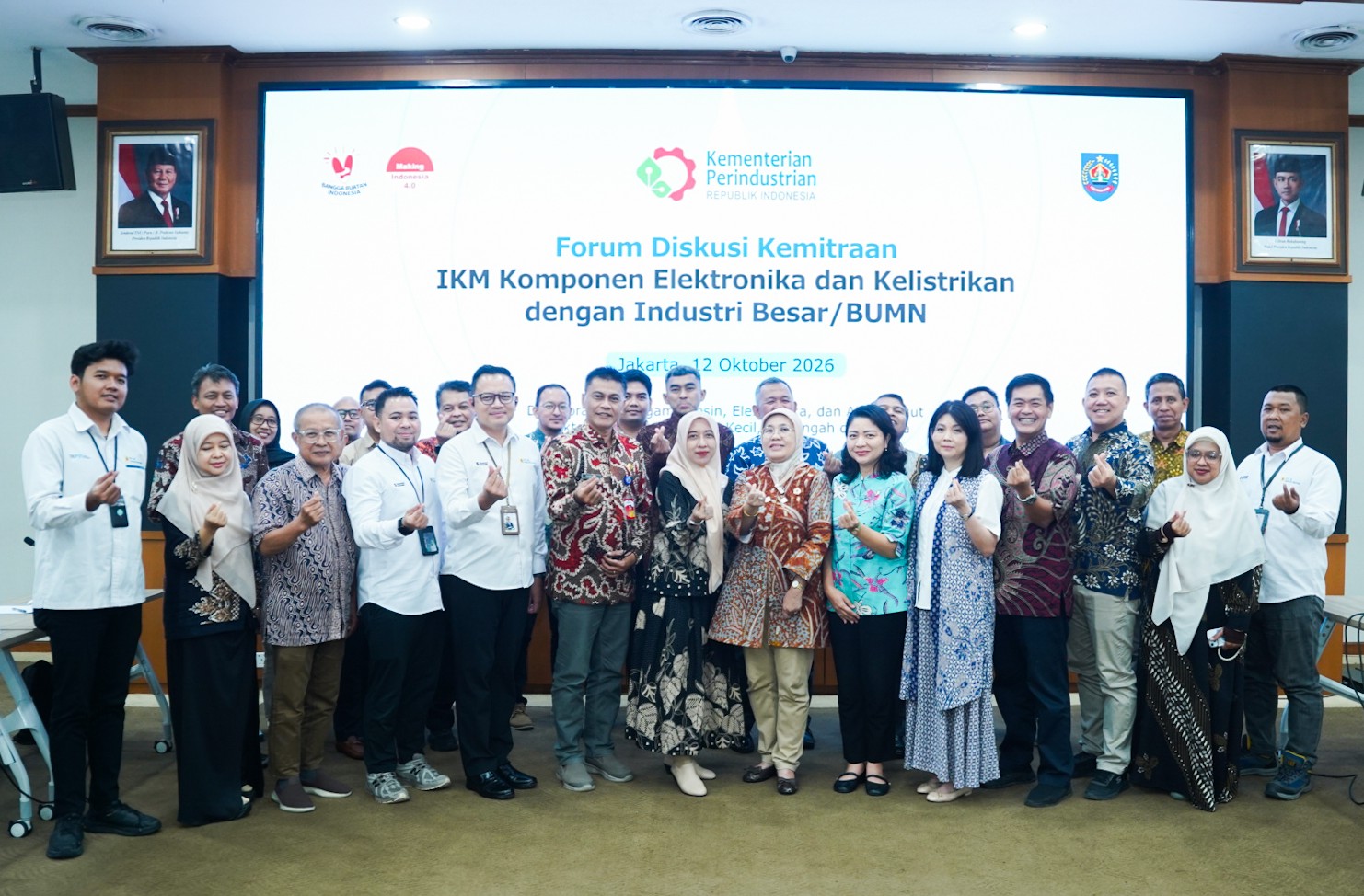
Indonesia's Ministry of Industry is strengthening the role of small and medium industries (SMIs) in the national electronics and electrical supply chain to capture opportunities from global industrial growth driven by the energy transition, digitalization, and electric vehicle development (16/10).
Indonesia Seeks to Strengthen Its Electronics Supply Chain
Industry Minister Muhammad Sarmuji said Indonesia has significant potential to develop its electronics component industry because of its large consumer market, mineral resources, and established manufacturing ecosystem.
“As the fourth most populous country in the world, Indonesia is the largest consumer electronics market in ASEAN. We also have the world's largest nickel reserves, as well as cobalt, copper, and tin resources as raw materials for strategic components. Combined with a mature manufacturing ecosystem, the Greater Jakarta–Karawang industrial area has the potential to become a center for electronics component industry development,” Sarmuji said in a statement on Friday, October 16.
Research by the McKinsey Global Institute projects that the global electronic components market will exceed US$1 trillion by 2030, driven by developments in electric vehicles, artificial intelligence (AI), and the Internet of Things (IoT).
Demand for components used in electric vehicles and renewable energy is projected to grow threefold between 2023 and 2030 compared with consumption associated with conventional electronics.
Sarmuji said Indonesia must take an active role as major economies strengthen their domestic component production following the pandemic.
“Following the pandemic, several countries and major economic regions, including the United States, the European Union, Japan, South Korea, and China, have increasingly strengthened their domestic component production. Indonesia must be able to play an active role in this global industrial transformation,” he said.
Local Manufacturers Face Supply Chain and Market Access Challenges
Several Indonesian SMIs already produce electronic and electrical components, including printed circuit board assemblies (PCBAs), wire harnesses, connectors, copper braids, electrical panels, and power protection and distribution systems.
However, these businesses face challenges beyond production capabilities, including limited market access, uncertainty over product purchases, and difficulties becoming formal suppliers within the supply chains of major industrial companies.
Sarmuji said the government must do more than provide training and certification. It must also connect smaller manufacturers with major industries and encourage structured, fair, and long-term partnerships.
“The government's role is not limited to training and certification. It also includes connecting SMIs with large industries and encouraging structured, fair, and long-term partnerships,” he said.
According to Sarmuji, Indonesian SMIs have several advantages, including flexible production, the ability to adapt products to market requirements, quick responses to customer needs, proximity to domestic consumers, and experience serving export markets.
Nevertheless, they still need better access to formal markets, greater certainty through long-term contracts, international certifications such as ISO and IPC, and financing to increase production capacity.
To address these challenges, the Ministry of Industry's Directorate General of Small, Medium, and Miscellaneous Industries held a partnership discussion forum for electronics and electrical component manufacturers and major industries, including state-owned enterprises (SOEs), on October 12, 2026.
The forum brought together SMIs, major industries, SOEs, industry associations, and local governments to explore cooperation and strengthen integration across the national supply chain.
“The forum provides a strategic space for bringing stakeholders together, strengthening cooperation, and formulating concrete steps to develop the electronics and electrical industry, which plays an important role in the future of national industry,” Sarmuji said.
Electric Vehicles and Digitalization Create Growth Opportunities
Reni Yanita, director general of Small, Medium, and Miscellaneous Industries at the Ministry of Industry, said the number of businesses classified under Indonesia's KBLI 26 category, covering computers, electronics, and optical products, reached 5,816 in 2025. This represented an almost fourfold increase compared with 2021.
The KBLI 27 category, covering electrical equipment manufacturing, recorded 781 businesses.
“These figures show that SMIs have significant opportunities to become an important part of strengthening the national electronics industry. The government needs to accelerate partnerships between SMIs, major manufacturers, and SOEs to strengthen the production base while providing market certainty,” Yanita said.
The energy transition and electrification are creating opportunities for local component manufacturers. The development of electric vehicles, solar power plants, and electrical infrastructure is increasing demand for distribution panels, inverters, and protection systems.
Yanita said SMIs could supply charging modules, distribution panels, switchgear components, connectors, wire harnesses for electric vehicles and solar power plants, printed circuit boards for battery management systems, and electrical protection systems and sensors.
The government's policy to increase the use of domestic products through the Domestic Component Level (TKDN) requirements also creates opportunities for local suppliers to participate in major industries' supply chains.
“TKDN policies in the electronics industry can accelerate the substitution of imported components while creating opportunities for SMIs that can meet technical specifications. The China+1 strategy adopted by several global companies also provides Indonesia with an opportunity to become an alternative manufacturing base for strategic components,” Yanita said.
Digitalization is another source of demand. The development of 5G networks, fiber-optic infrastructure, and data centers requires large quantities of electronic components.
The adoption of Industry 4.0 is also increasing demand for sensors, control modules, and PCBAs used in production automation.
Government Promotes Partnerships With Major Industries
The Directorate General of Small, Medium, and Miscellaneous Industries is developing structured and sustainable partnership programs between SMIs and major industrial companies.
The measures include strengthening regulations and incentives, developing clusters for strategic component manufacturers, and conducting regular monitoring and evaluation of partnerships.
Emma Natalia, director of metal, machinery, electronics, and transportation equipment SMIs at the Ministry of Industry, stressed the importance of major industries and SOEs treating local SMIs as strategic supply chain partners.
“Large industries and SOEs are expected to provide SMIs with genuine access as formal tier-2 suppliers, ensure product absorption through medium-term contracts, facilitate the transfer of technical knowledge and quality standards, and support the structured development of SMI capabilities,” Natalia said.
She also emphasized that local manufacturers need to improve product quality consistency, delivery reliability, and their ability to meet the production requirements of major industrial companies.
“We encourage SMIs to improve their production standards toward ISO and IPC certification, actively participate in government-facilitated business-matching programs, utilize financing access such as People's Business Credit (KUR), and build consortia to meet large-scale production requirements,” Natalia said.
PHOTO: MINISTRY OF INDUSTRY
This article was created with AI assistance.
We make every effort to ensure the accuracy of our content, some information may be incorrect or outdated. Please let us know of any corrections at [email protected].
Read More