





 Friday, 25-09-26








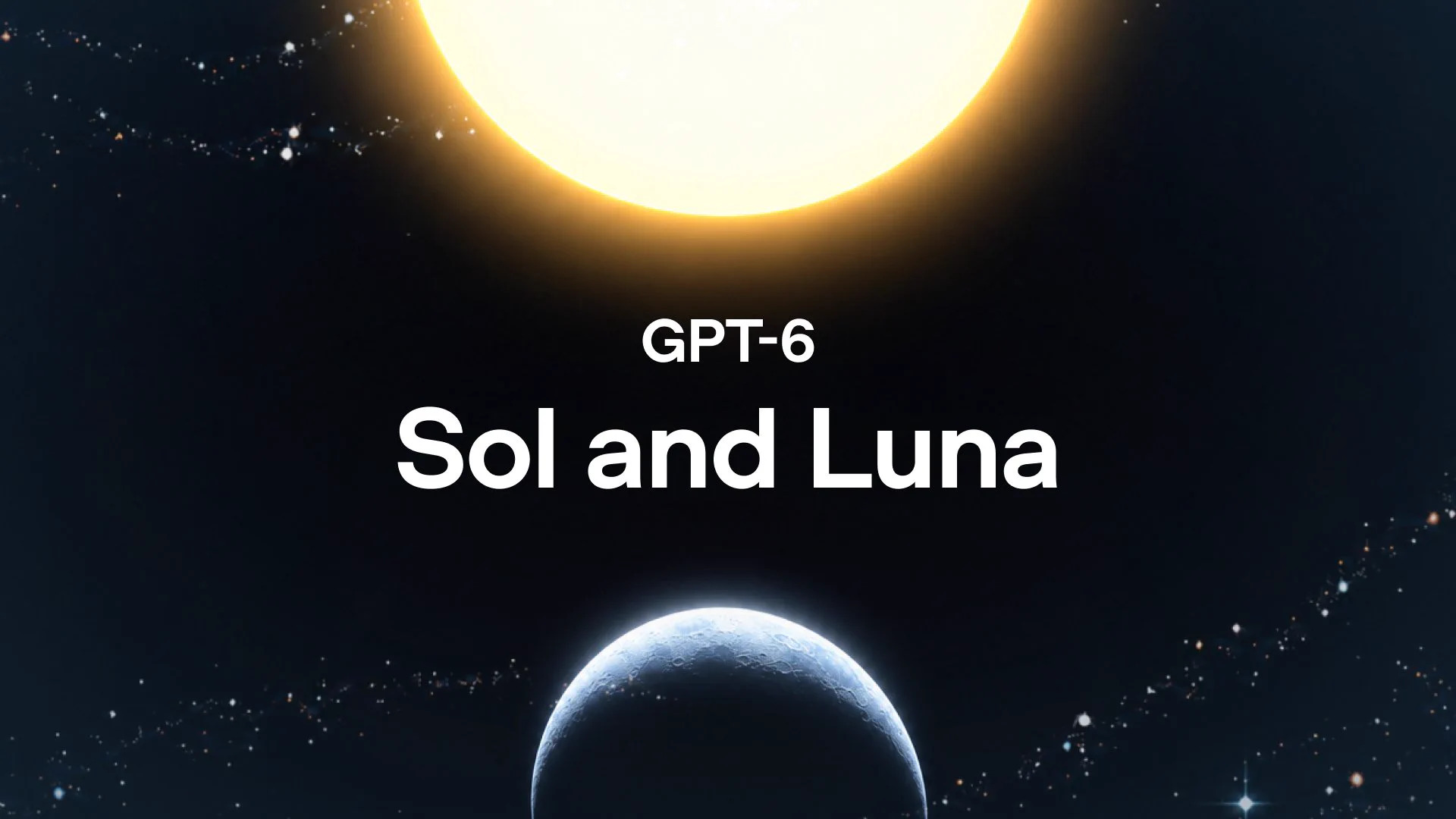
The artificial intelligence sector experienced a landmark shift as OpenAI officially introduced its newest frontier generation, revealing OpenAI GPT-6 Sol and Luna to developers, businesses, and technology enthusiasts worldwide. This release represents a departure from single-model releases, moving instead toward a coordinated dual-engine model framework tailored to distinct computational requirements. In recent years, artificial intelligence platforms faced a growing tension between massive reasoning depth and real-time operational efficiency. By introducing OpenAI GPT-6 Sol and Luna, OpenAI seeks to resolve this dilemma, providing a paired release designed to handle heavy analytical processing alongside ultra-fast background performance.
The introduction of these two specialized model engines signals a mature phase in artificial intelligence engineering. Rather than asking users to compromise between high computing costs and fast response times, the new architecture integrates both spectrums into one cohesive environment. Understanding how these two engines function individually and collaboratively provides valuable insight into where artificial intelligence infrastructure is heading in the coming years.
The Evolution of Next-Generation Artificial Intelligence
For several years, the race among leading artificial intelligence research labs centered almost exclusively on raw scale. Models grew progressively larger, expanding their parameter counts into hundreds of billions and eventually trillions. While this dramatic expansion brought unprecedented capabilities in natural language understanding, creative writing, and basic coding, it also created significant friction. Massive models required colossal server resources, produced higher latency, and incurred substantial financial costs for enterprise deployment.
As organizations attempted to integrate these systems into production software, the limitations of the single-large-model approach became increasingly obvious. Simple tasks like routing a customer support inquiry or translating a quick voice message did not require a trillion-parameter model calculating complex multi-step reasoning. Conversely, smaller specialized models often lacked the broad cognitive capability required for intricate engineering problems, medical data analysis, or advanced legal synthesis.
The release of OpenAI GPT-6 Sol and Luna solves this structural imbalance through a dual-engine paradigm. Instead of building one giant system that attempts to be everything at once, OpenAI designed two distinct engines that operate under a unified framework. This evolution mirrors computer processing evolution, where dedicated graphics processing units handle specialized mathematical tasks alongside central processing units. By segmenting responsibilities, the overall system achieves vastly improved performance while dramatically optimizing computational resource consumption.
Understanding OpenAI GPT-6 Sol: High-Powered Computation and Deep Reasoning
The first pillar of this launch is Sol, the high-capacity computing engine designed for heavy cognitive workloads. Named after the sun to reflect its centralized power and high output, Sol serves as the heavy lifter within the ecosystem. It is specifically engineered to handle highly complex, multi-layered problem-solving tasks that demand intense computational depth, long-context retention, and multi-step reasoning capabilities.
Sol features an expanded dynamic context window capable of retaining and synthesizing millions of data tokens without losing semantic accuracy. This makes it ideal for enterprise-level applications, such as analyzing full legal libraries, evaluating large-scale software codebases, processing clinical research documentation, and constructing complex financial forecasts. When faced with intricate logic puzzles or mathematical modeling, Sol utilizes an expanded internal chain-of-thought mechanism, evaluating multiple hypotheses simultaneously before rendering its final output.
Furthermore, Sol introduces enhanced multimodal capabilities. It does not merely process text and images in isolation; it integrates visual schema, tabular data, audio spectrums, and programmatic code into a unified reasoning map. Developers working on advanced robotics, automated scientific discovery, and comprehensive data visualization will find Sol to be an indispensable asset. While Sol requires greater computational overhead compared to lighter models, its efficiency per reasoning unit has been vastly improved relative to previous flagship systems.
Exploring OpenAI GPT-6 Luna: Lightweight Efficiency and Real-Time Processing
While Sol provides raw analytical horsepower, Luna serves as the nimble, low-latency engine designed for real-time interaction and edge deployment. Named after the moon to symbolize ambient, continuous, and efficient illumination, Luna addresses the urgent need for instantaneous artificial intelligence responses across personal devices and everyday software applications.
Luna excels at tasks where immediate feedback is critical. Standard conversational interactions, automated voice assistants, rapid document summarization, micro-code completions, and routine data extraction fall directly under Luna's operational umbrella. Operating with sub-50 millisecond latency, Luna delivers responses at a speed that feels natural and instantaneous to human users, eliminating the noticeable processing pauses common in legacy large language models.
Another key aspect of Luna is its remarkable resource efficiency. OpenAI engineered Luna using novel compression, quantization, and sparse activation techniques, allowing it to execute sophisticated natural language understanding on limited hardware infrastructure. This efficiency dramatically lowers API operational costs for enterprise developers, making large-scale consumer applications economically viable. Whether running in cloud microservices or local edge devices, Luna provides consistent, low-overhead intelligence for continuous daily tasks.
How Sol and Luna Work Together in the Dual-Engine Architecture
While Sol and Luna possess distinct strengths, their true power lies in how they function in tandem. Central to OpenAI GPT-6 Sol and Luna is an intelligent context routing controller that acts as an automated traffic director. When a query enters the system, the routing controller analyzes the intent, complexity, and operational constraints of the request in real time.
For routine queries, such as drafting an email reply, organizing a daily calendar, or retrieving a simple fact, the system routes the request directly to Luna. This ensures immediate execution with minimal resource usage. However, if the user asks a follow-up question that requires deep research, mathematical calculation, or code generation, the routing system seamlessly hands off the contextual state to Sol. Sol executes the heavy cognitive processing and returns the response back to the primary stream.
This dynamic handoff operates transparently without interrupting the user experience. By managing computational load in real time, the dual-engine architecture maximizes system throughput and minimizes compute costs. Enterprise organizations no longer need to build custom model switching pipelines or maintain separate infrastructure stacks; the OpenAI GPT-6 Sol and Luna framework manages the delegation process automatically.
Key Technical Breakthroughs Behind the GPT-6 Ecosystem
The arrival of OpenAI GPT-6 Sol and Luna is built upon several major architectural innovations developed over recent years. One of the primary technical breakthroughs is the implementation of zero-loss contextual state persistence. In older model architectures, extended conversations or large inputs often led to context drift, where early details were forgotten or misaligned. The new architecture maintains structural memory alignment across extended multi-session interactions, ensuring consistent context retention.
Another key breakthrough lies in alignment and factual reliability. OpenAI incorporated real-time verification modules directly into the decoding process of both Sol and Luna. These verification systems continuously audit output assertions against verified reference structures, resulting in a dramatic reduction in factual errors and hallucinations. For critical industries like healthcare, finance, and legal compliance, this improved reliability represents a major practical advance.
Additionally, both models benefit from advanced synthetic data pre-training and self-correcting alignment methodologies. During training, the models were exposed to millions of complex problem-solving simulations where they learned to identify and correct logical flaws in their own outputs. This self-refinement capability allows Sol and Luna to produce more cohesive, robust, and logically consistent outputs across diverse domains.
Industry Impacts and Practical Real-World Applications
The dual-engine architecture of OpenAI GPT-6 Sol and Luna opens up new possibilities across numerous industrial and commercial sectors. In the software development industry, Luna can handle real-time inline code completion within code editors, while Sol operates in the background to review entire system repositories, spot security vulnerabilities, and generate comprehensive documentation.
In healthcare, medical professionals can utilize Luna for fast patient intake logging and preliminary administrative charting, while using Sol to analyze complex diagnostic imagery, correlate laboratory results, and assist in clinical trial matching. This division of labor allows healthcare systems to streamline administrative tasks without compromising the depth required for high-stakes clinical decision support.
The financial service sector also stands to gain immensely. Financial analysts can deploy Luna to monitor real-time news feeds, trigger immediate market alerts, and filter standard earnings reports. Simultaneously, Sol can be deployed to build dynamic risk models, run stress-test simulations across complex portfolios, and draft regulatory compliance reports. The synergy between high speed and deep analysis transforms how financial institutions analyze data and manage risk.
The Future Outlook for Autonomous AI Deployment
The launch of OpenAI GPT-6 Sol and Luna marks an important milestone in the path toward truly useful autonomous systems. By balancing deep cognitive capabilities with low-latency efficiency, OpenAI has established a practical template for how future artificial intelligence models will be designed and deployed.
As businesses continue to adopt this dual-engine approach, the focus will likely shift from basic tool usage to complex autonomous workflow management. Autonomous agents powered by Sol's strategic planning and Luna's real-time operational execution will soon manage multi-step business operations, complex customer lifecycles, and global supply chain logistics. The release of Sol and Luna provides the underlying infrastructure required to make these advanced autonomous implementations a practical reality.
Read More