





 Sunday, 20-09-26








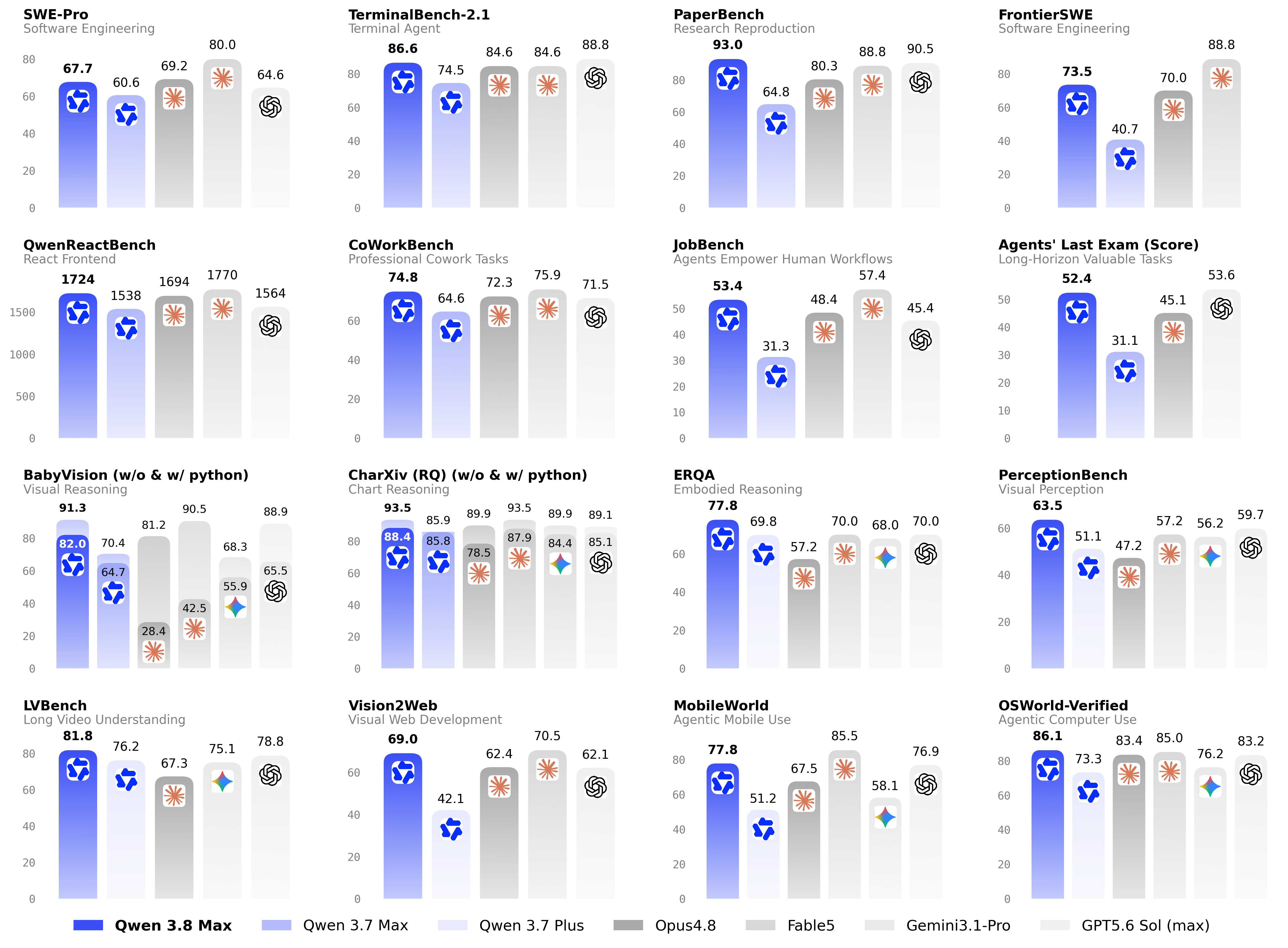
Qwen officially launched Qwen3.8-Max, describing it as the most capable model in the Qwen family with comprehensive improvements across coding, work, research, and long-horizon tasks. The company also announced that it will release the open weights of a Qwen-Max-class model for the first time next week. (03/08)
Built on the architectural foundation of Qwen 3.5, Qwen3.8-Max features 2.4 trillion parameters with 95 billion active parameters. According to Qwen, the model is designed to answer more challenging questions and complete complex end-to-end tasks with greater reliability.
Qwen3.8-Max Demonstrates Autonomous Coding and Research Capabilities
Qwen evaluated the model through three coding challenges that required it to independently write and execute code without human assistance.
In one experiment, Qwen3.8-Max created the oh-my-cli project from an empty repository during an autonomous coding run lasting more than 10 days.
The model built a self-evolving engineering system that transformed user feedback and community practices into GitHub issues, automatically completed tasks, generated code, performed testing, and fixed detected problems.
As of July 30, 2026, after approximately 16 days of autonomous operation, the repository recorded 265 commits, 127 pull requests, and 151 issues, according to Qwen.
Qwen also tasked the model with reproducing the research paper "Unified Data Selection for LLM Reasoning." Starting only with the paper and GPU resources, the model independently created the required data-processing scripts, training pipeline, and evaluation framework.
During approximately five days of continuous work, Qwen3.8-Max generated about 7,600 lines of code, completed more than 1,100 actions, and conducted 33 rounds of GPU training. After reproducing the paper's six main findings, the model tested 18 improvement ideas across four rounds and produced a method that improved the paper's reported performance by 2.7 points on the AIME24 benchmark.
The company also entered Qwen3.8-Max into the WWW2025 Multimodal Dialogue Intent Recognition Challenge on Alibaba Cloud's Tianchi platform. Working independently within 24 hours, the model submitted 45 entries, achieving a final accuracy score of 0.853 and outperforming 458 of the 526 participating human teams.
Model Expands Performance Across Professional Workflows
Qwen said Qwen3.8-Max was developed to improve performance across real-world professional workflows by scaling reinforcement learning environments and computing resources.
The company highlighted examples involving corporate compliance, UI and UX design, restaurant menu development, structural engineering, rehabilitation therapy, and sports analytics.
In one compliance task, the model identified 1,284 relevant clauses from hundreds of documents in less than one hour. Qwen stated that the same review would typically require a paralegal team working together for around one week.
Qwen also demonstrated the model's Dynamic Workflows capability through quantitative research. Starting from a one-line task description, Qwen3.8-Max independently planned and completed an ETF rotation strategy by building data systems, creating factors, conducting repeated backtests, and refining its workflow throughout the process.
Qwen3.8-Max Handles Long-Horizon Engineering Tasks
Qwen also demonstrated the model's ability to complete complex engineering projects through an autonomous digital chip design task.
Beginning with only a task description, an empty RTL workspace, and evaluation scripts, Qwen3.8-Max independently carried out algorithm design, RTL generation, debugging, synthesis, and repeated optimization without human intervention.
During approximately 500 interaction turns and 71 evaluations, the model reduced the synthesized gate count from 8,298 gates to 678 gates through multiple stages of architectural optimization.
Qwen further evaluated the design using OpenROAD for physical implementation. The final chip layout reduced the die size from 106 × 106 μm² to 46 × 46 μm², decreased wire length from 33,369 μm to 4,187 μm, and achieved timing closure at 500 MHz.
PHOTO: QWEN AI
This article was created with AI assistance.
We make every effort to ensure the accuracy of our content, some information may be incorrect or outdated. Please let us know of any corrections at [email protected].
Read More