





 Thursday, 15-10-26








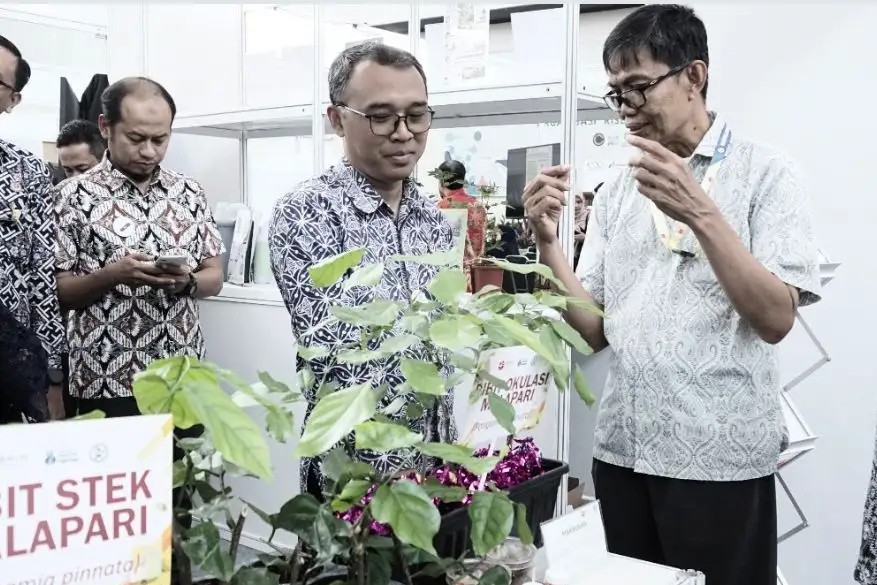
Indonesia's National Research and Innovation Agency (BRIN) has introduced the potential of Malapari (Pongamia pinnata) as a renewable energy source that could support the country's energy transition while helping rehabilitate degraded land. The research was presented during the Capacity Building and Expo of BRIN's Biological and Environmental Research Organization (ORHL) 2026, held in Cibinong, Bogor Regency (08–09/07).
The event featured eight thematic exhibitions showcasing biological and environmental research and innovation from upstream to downstream. One of the featured exhibitions focused on energy research, highlighting Malapari development by the Macropropagation Technology Research Group at BRIN's Applied Botany Research Center.
Malapari Offers Biodiesel and SAF Feedstock Potential
Applied Botany Research Center researcher Danu said Malapari is a multipurpose plant that produces vegetable oil that can be used as feedstock for biodiesel. He added that the oil also has the potential to be developed into sustainable aviation fuel (SAF).
"Malapari is one of the vegetable oil-producing plants that can be used as a feedstock for biodiesel. Even its oil also has the potential to be developed into sustainable aviation fuel (SAF)," he said.
According to Danu, Malapari can grow on degraded and marginal land that is less productive for food crops. Its root system contains nitrogen-fixing nodules that help improve soil quality, making the plant suitable for land rehabilitation while providing a renewable energy source.
Nearly Every Part of the Plant Has Economic Value
Besides producing oil for bioenergy, almost every part of the Malapari plant has economic value. The seed cake left after oil extraction has the potential to be used as livestock feed, while its leaves are being developed as raw material for skincare products through research collaboration with industry partners.
BRIN Builds Partnerships to Develop the Malapari Supply Chain
To support the downstream development of its research, BRIN's Macropropagation Technology Research Group has established collaborations with PT SANTI Group, Four Pride, PT SANTI Energi Hijau, PT Rumah Tani Nusantara, PT Pinna Foresta Raya, and the Ministry of Forestry. The partnerships are focused on developing a sustainable Malapari supply chain.
"We are developing Malapari plantations in several locations as feedstock sources. The development is carried out in parallel with the construction of processing facilities so that when the feedstock supply is available, the processing industry will also be ready to operate," Danu explained.
Danu added that BRIN's Applied Botany Research Center is producing high-yield Malapari seedlings to provide quality planting materials before expanding production areas with local communities.
"We are currently developing core production areas first. After the planting area and feedstock production capacity are sufficient, development can be expanded through partnerships with communities so that the economic benefits can be enjoyed more widely," he said.
BRIN Successfully Produces Biodiesel from Malapari
Through the ORHL 2026 Expo, Danu said BRIN hopes more people will become familiar with Malapari as one solution to future energy challenges. He said developing plant-based energy is important for reducing dependence on fossil fuels while supporting more sustainable development.
Danu also said BRIN's research team has successfully produced biodiesel from Malapari. He added that interest from companies, including those from Japan, shows the strong potential of the Indonesian native plant to become a competitive bioenergy commodity in the global market.
"We have successfully produced biodiesel from Malapari. We hope more people become familiar with this plant and are interested in developing it. Interest from overseas companies, including Japan, is already quite high. This shows that a plant that grows in Indonesia has great potential to become a competitive bioenergy commodity at the global level," he concluded.
PHOTO: BRIN
This article was created with AI assistance.
We make every effort to ensure the accuracy of our content, some information may be incorrect or outdated. Please let us know of any corrections at [email protected].
Read More