





 Sunday, 04-10-26








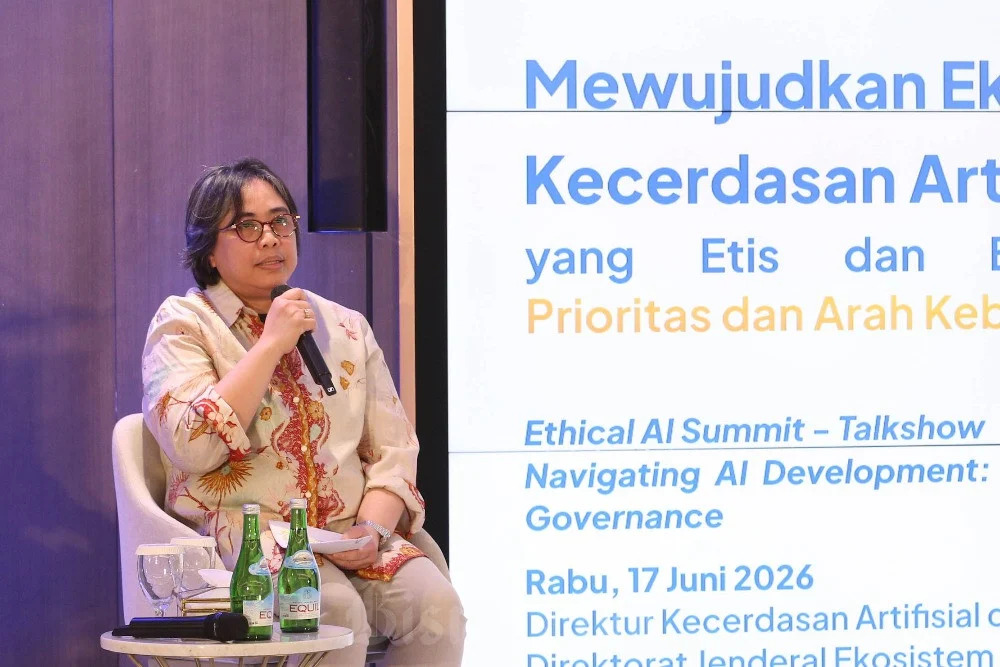
Indonesia is sharpening its AI policy message at a moment when global scrutiny over artificial intelligence is rising fast. The direction from Komdigi is clear enough: AI development should not move ahead without ethical guardrails, and those guardrails should be aligned with internationally recognized frameworks. That positioning matters because the debate is no longer only about innovation speed. It is about trust, accountability, and whether AI systems can be deployed in a way that is socially acceptable, legally defensible, and commercially sustainable. UNESCO’s AI ethics recommendation and the OECD AI Principles are two of the best known global references in this space, and both emphasize human rights, transparency, fairness, and human oversight.
For Indonesia, this is not just a rhetorical shift. Komdigi has already been working on a national framework for AI ethics and a broader AI roadmap. In May 2026, Komdigi said the final discussion of two draft presidential regulations had been completed, one on AI ethics and another on the national AI roadmap for 2026 to 2029. In June 2026, the ministry again emphasized that Indonesia urgently needs its own AI rules because the country has a huge internet user base and must ensure AI innovations are accountable.
This makes the current messaging especially relevant for international audiences. When Komdigi says its principles refer to international standards, the practical meaning is that Indonesia wants to be seen as a serious jurisdiction, not a regulatory outlier. That is important for investors, technology vendors, and foreign partners that are evaluating whether to build, sell, or localize AI products in Indonesia. It also helps explain why AI Ethics Standards is the right keyword for this story. The core issue is not just AI adoption. It is the policy architecture around AI adoption.
Why AI Ethics Standards Are Now A Strategic Policy Signal
The strongest reason governments are being pushed to formalize AI Ethics Standards is that AI systems can create real world harms when they are deployed without clear rules. UNESCO says its recommendation is built on human rights and dignity, with core principles including transparency, fairness, and human oversight. The OECD similarly frames AI governance as a way to promote trustworthy AI that respects human rights and democratic values. Those are not abstract concepts. They are the baseline expectations that many countries now use to judge whether AI policy is credible.
Indonesia’s own policy language is moving in the same direction. Komdigi has repeatedly stressed the importance of ethical, transparent, and accountable AI governance. In April 2026, the ministry said national regulation would be used to create a governance framework that encourages innovation while keeping AI ethical and accountable. In February 2026, Komdigi also highlighted that data quality and data security are essential to protecting the public from biased, manipulated, or unreliable AI outcomes. Taken together, these signals show that AI Ethics Standards are not being treated as decorative principles. They are being positioned as operational requirements.
There is also a geopolitical layer to this. Indonesia is part of a broader global competition to define how AI should be regulated. Countries that can align with established norms tend to find it easier to attract investment, cooperate with global firms, and avoid unnecessary friction with foreign regulators. That is why references to UNESCO and OECD matter so much. They give Indonesia an internationally legible vocabulary for AI governance, which is useful when explaining policy choices to partners who may not be familiar with the local regulatory context.
Komdigi’s Approach Points To A Hybrid Model
Komdigi’s current approach appears to combine ethics, technical standards, and formal regulation. That hybrid model is sensible because ethics alone cannot enforce compliance, while regulation alone can become outdated if it is too rigid. In May 2026, Komdigi explicitly said ethical principles must be translated into binding regulation with sanctions and penalties, and not remain only as moral appeals. That is a strong clue about the direction of policy design. The government seems to want a framework where AI Ethics Standards guide the substance of the rules, while legal instruments provide the enforcement power.
This is also consistent with Komdigi’s wider work on digital governance. The ministry has stressed standards around data quality, security, and responsible use because those are the areas where AI systems often fail in practice. If the data is biased, incomplete, or poisoned, the output will be flawed regardless of how advanced the model is. That is why policy conversations around AI are increasingly moving away from hype and toward boring but essential questions like data integrity, auditability, and oversight. Those details are what make AI safe enough to scale.
A second reason this hybrid model matters is sectoral adoption. Komdigi has already been discussing AI governance in media and broadcasting, and it has supported regional coordination in ASEAN on issues like deepfakes and AI content labeling. Those efforts suggest that the ministry sees AI not as one single policy file, but as a cross sector governance challenge. In that context, AI Ethics Standards become the common denominator that can apply across media, public services, education, telecom, and other sectors where AI tools are being deployed.
What This Means For Businesses, Investors, And The Public
For businesses, the immediate implication is compliance readiness. Firms that want to build AI products in Indonesia should expect greater attention to transparency, data governance, and accountability. That means documenting model behavior, improving explainability where possible, monitoring harmful outputs, and preparing for rules that may require labeling or disclosure in some use cases. It also means that companies importing AI tools from abroad will need to check whether their systems fit Indonesian expectations rather than assuming global products will automatically pass local scrutiny. This is where AI Ethics Standards stop being a policy talking point and become a market access issue.
For investors, the key question is predictability. A country with transparent AI governance is easier to price. The presence of draft presidential regulations, ongoing interministerial work, and reference points from UNESCO and OECD all reduce uncertainty. That does not eliminate regulatory risk, but it makes the risk more legible. In practical terms, investors tend to prefer jurisdictions where ethical principles are being translated into rules, rather than debated endlessly without closure. Indonesia seems to be moving toward that kind of structure.
For the public, the benefit should be simpler: better protection. AI systems can improve services, but they can also amplify mistakes at scale. Komdigi’s emphasis on security, transparency, and accountability indicates an effort to reduce the chance that AI will be deployed in ways that harm users through bad data, hidden decision making, or weak oversight. If the final regulations stay close to the government’s current messaging, the public should see AI policy framed not as a race to automate everything, but as a controlled effort to make AI useful without letting it become reckless.
The Bigger Picture For Indonesia’s AI Roadmap
Indonesia’s next challenge is implementation. A policy can look strong on paper and still fail if enforcement is unclear, institutions are under resourced, or industries do not understand what is expected of them. That is why the next stage will matter more than the headline. The government will need to finalize the AI ethics regulation, clarify how it connects to existing laws, and explain how compliance will be measured. It will also need to keep the framework flexible enough to accommodate fast changing AI use cases without forcing constant rewrites.
The broader opportunity is significant. If Indonesia can anchor its AI agenda in credible AI Ethics Standards, it can build trust at home and abroad at the same time. It can reassure partners that it is aligning with global norms, while also giving domestic stakeholders a clearer picture of what responsible AI should look like. That combination is valuable because AI policy is increasingly judged not only by the sophistication of the rules, but by whether those rules can support innovation, protect users, and survive international scrutiny.
Read More