





 Tuesday, 22-09-26








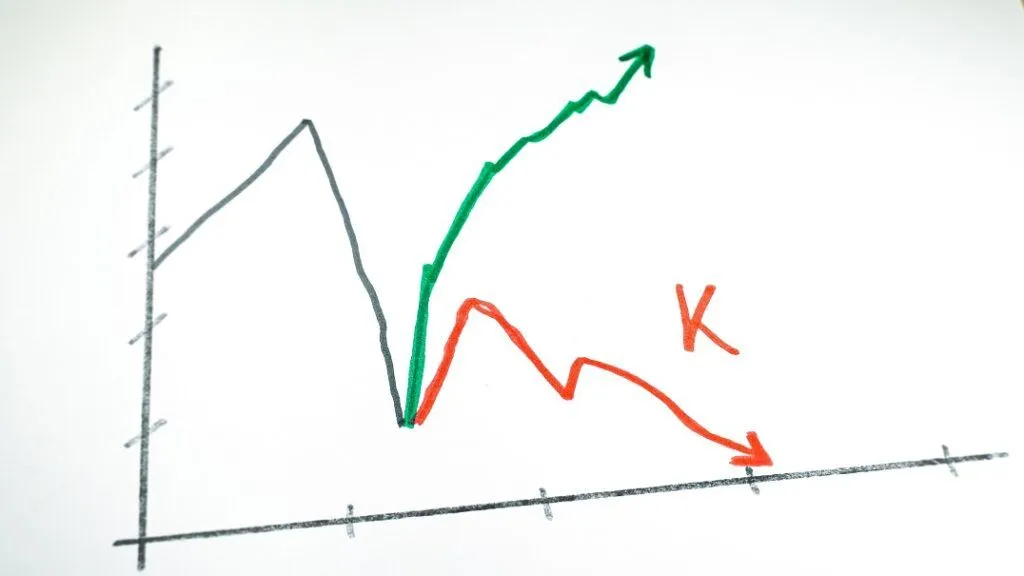
The global economy is entering a new phase of uncertainty, and one concept is increasingly dominating the conversation among economists and financial institutions: the K-shaped economy. Highlighted in recent analysis by Goldman Sachs, this trend reflects a divergence in economic outcomes where certain sectors and income groups continue to thrive while others struggle to keep pace.
Unlike a uniform recovery, a K-shaped economy suggests that growth is uneven and fragmented. While high-income individuals, large corporations, and technology-driven sectors experience strong expansion, lower-income groups and traditional industries face stagnation or decline. As we move further into 2026, the implications of a K-shaped economy are becoming more pronounced, raising concerns about long-term inequality and economic stability.
Understanding the K-Shaped Economy and Its Origins
The concept of a K-shaped economy gained prominence during the global recovery from the COVID-19 pandemic. Instead of a synchronized rebound, the economy split into two distinct trajectories. The upper arm of the “K” represents sectors and individuals benefiting from structural shifts such as digitalization and remote work, while the lower arm reflects those left behind.
In the current context, the K-shaped economy is being driven by several key factors. Technological advancement is a major contributor, as industries that leverage artificial intelligence, automation, and digital platforms continue to grow rapidly. At the same time, sectors reliant on physical labor or traditional business models are facing increasing challenges.
Monetary policy has also played a role. Low interest rates and liquidity injections have supported asset prices, benefiting those with investments in stocks and real estate. This has contributed to wealth accumulation at the top, further reinforcing the K-shaped economy dynamic.
Additionally, labor market shifts are exacerbating the divide. High-skilled workers in technology and finance are in strong demand, commanding higher wages and better job security. In contrast, low-skilled workers face greater uncertainty, limited opportunities, and slower wage growth.
How Goldman Sachs Sees the K-Shaped Economy in 2026
According to insights from Goldman Sachs, the K-shaped economy is not just a temporary phenomenon but a structural trend that could define the economic landscape in the coming years. The firm’s analysis suggests that disparities in growth and income are likely to persist, driven by ongoing technological disruption and shifting global dynamics.
One of the key observations is that corporate performance is increasingly polarized. Large, well-capitalized companies with access to advanced technology are outperforming smaller businesses that lack resources to adapt. This divergence is a hallmark of the K-shaped economy and has significant implications for competition and market structure.
Goldman Sachs also highlights the role of consumer behavior. Higher-income households continue to spend on premium goods and services, supporting growth in certain sectors. Meanwhile, lower-income consumers are more constrained, limiting demand in other parts of the economy.
The financial sector is another area where the K-shaped economy is evident. Strong performance in equity markets and other financial assets has benefited investors, while those without exposure to these markets have not experienced the same gains. This further widens the gap between different income groups.
Impact of K-Shaped Economy on Businesses and Industries
The K-shaped economy is reshaping the business landscape in profound ways. Companies must navigate an environment where demand patterns are increasingly fragmented, and growth opportunities are unevenly distributed.
For businesses operating in high-growth sectors such as technology, healthcare, and digital services, the K-shaped economy presents significant opportunities. These industries are benefiting from strong demand and favorable market conditions, allowing them to expand rapidly.
However, companies in traditional sectors face a more challenging outlook. Retail, manufacturing, and hospitality industries, for example, must contend with changing consumer preferences, rising costs, and competitive pressures. In a K-shaped economy, success often depends on the ability to adapt and innovate.
The divergence also affects investment strategies. Investors are increasingly focusing on sectors and companies that are positioned to benefit from long-term trends such as digital transformation and sustainability. This can lead to further concentration of capital in already successful industries, reinforcing the K-shaped economy dynamic.
For small and medium-sized enterprises, the challenges are particularly acute. Limited access to capital and technology can hinder their ability to compete, making it harder to keep up with larger players. This underscores the importance of supportive policies and initiatives to level the playing field.
Social and Economic Implications of K-Shaped Economy
Beyond business and markets, the K-shaped economy has significant social implications. The widening gap between different income groups can lead to increased inequality, social tension, and political instability.
One of the most pressing concerns is the impact on living standards. While some individuals enjoy rising incomes and improved quality of life, others struggle with stagnant wages and higher costs of living. This divergence can create a sense of imbalance and dissatisfaction within society.
The K-shaped economy also affects access to opportunities. Education, healthcare, and employment prospects are often linked to economic status, meaning that disparities can perpetuate across generations. Addressing these challenges requires coordinated efforts from governments, businesses, and communities.
In addition, the trend has implications for economic growth. High levels of inequality can dampen overall demand, as lower-income households have less purchasing power. This can limit the potential for sustained economic expansion and create vulnerabilities in the global economy.
Governments are increasingly aware of these risks and are exploring policies to mitigate the effects of the K-shaped economy. These may include targeted fiscal measures, investment in education and training, and support for vulnerable sectors.
Navigating the Future in a K-Shaped Economy
As the K-shaped economy continues to evolve, businesses and individuals must adapt to a changing landscape. For companies, this means developing strategies that account for uneven growth and shifting demand patterns. Flexibility, innovation, and resilience will be key to success.
For workers, the emphasis is on skills development and adaptability. The demand for digital and technical skills is expected to remain strong, making continuous learning essential. Those who can align their capabilities with market needs are more likely to thrive in a K-shaped economy.
Investors, meanwhile, must navigate a complex environment where opportunities and risks are closely intertwined. Understanding the drivers of the K-shaped economy can help inform more effective investment decisions.
Ultimately, addressing the challenges of a K-shaped economy will require a collective effort. Policymakers, businesses, and society must work together to ensure that growth is inclusive and sustainable. This includes creating opportunities for all segments of the population and reducing barriers to participation in the economy.
Conclusion
The K-shaped economy is emerging as a defining feature of the global economic landscape in 2026. As highlighted by Goldman Sachs, the divergence between winners and losers is becoming more pronounced, with significant implications for businesses, investors, and society.
While the trend presents opportunities for certain sectors, it also raises important questions about inequality and long-term stability. Navigating this environment will require strategic thinking, adaptability, and a commitment to inclusive growth.
As the world continues to grapple with rapid technological change and economic uncertainty, the K-shaped economy serves as a reminder that not all recoveries are created equal. The challenge ahead is to bridge the gap and ensure that the benefits of growth are shared more broadly.
Read More