





 Saturday, 13-06-26








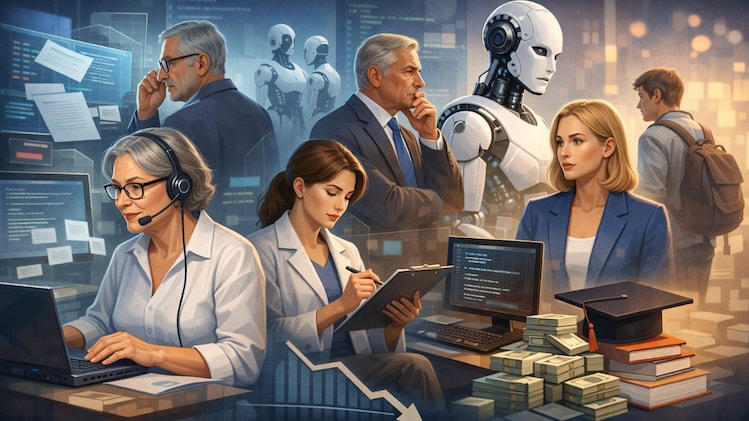
Artificial intelligence is rapidly transforming the global workforce, raising new questions about how automation will reshape employment in the coming decade. A recent study by the AI research company Anthropic has highlighted the growing impact of generative AI systems on the labor market, identifying which jobs are most vulnerable to automation.
The research suggests that the risk of AI job displacement is especially high among knowledge workers who perform repetitive cognitive tasks. While automation has historically replaced manual labor in manufacturing and logistics, the latest wave of artificial intelligence technologies is targeting office based professions.
According to the analysis, roles involving writing, data analysis, administrative support, and certain programming tasks may face the highest levels of exposure. These findings indicate that the AI job displacement trend could fundamentally reshape how modern knowledge work is performed across industries.
As generative AI systems become more capable and widely adopted, businesses are beginning to integrate these tools into everyday workflows. The transition could improve productivity and efficiency, but it also raises concerns about long term employment patterns and the future structure of the workforce.
Understanding The Scope Of AI Job Displacement
Anthropic’s research analyzed millions of real world interactions with AI systems in order to understand how artificial intelligence is currently being used in professional tasks. The results provide one of the clearest pictures yet of how generative AI may influence employment.
The study found that artificial intelligence tools are already being used for a wide range of tasks that were traditionally performed by human workers. These tasks include drafting documents, summarizing information, generating code, conducting research, and assisting with customer support.
In many cases, AI systems are not fully replacing workers but rather augmenting their productivity. However, the increasing capabilities of these technologies mean that certain job functions may eventually become fully automated.
The concept of AI job displacement therefore refers to the gradual replacement or transformation of tasks performed by humans. Instead of eliminating entire occupations immediately, AI often automates specific components of a job.
For example, a marketing professional might still oversee a campaign strategy, but AI tools could generate advertising copy, analyze consumer data, and produce reports automatically. Over time, this process could reduce the number of employees needed for certain tasks.
This shift represents a new phase of technological disruption in the labor market.
Which Jobs Face The Highest Risk
One of the most significant findings from the research is that AI job displacement risk is concentrated in specific types of occupations. Unlike earlier waves of automation that primarily affected factory workers, generative AI is targeting white collar professions.
The analysis suggests that knowledge based roles are particularly exposed because they rely heavily on language processing, information synthesis, and analytical reasoning. These are precisely the areas where modern AI systems excel.
Administrative assistants, customer support representatives, and office clerks are among the professions most vulnerable to AI job displacement. Many of their routine responsibilities such as scheduling meetings, managing documents, and answering common questions can be handled by intelligent software systems.
Another category facing potential disruption includes professionals in writing intensive roles. Content creators, technical writers, and communication specialists may find that AI tools can generate large volumes of text quickly and efficiently.
Software development is another field where automation is increasing rapidly. AI coding assistants can already generate functional code, debug programs, and recommend improvements to developers. While these tools are designed to assist engineers rather than replace them entirely, they could significantly reduce the need for entry level programmers.
Legal research and financial analysis also fall within the category of tasks highly exposed to AI job displacement. AI systems can process large datasets and identify patterns much faster than human analysts, enabling organizations to automate parts of these professions.
However, the research also notes that some occupations remain relatively resistant to automation. Jobs requiring physical dexterity, complex interpersonal communication, and creative problem solving are less likely to be fully automated in the near future.
AI As A Productivity Tool Rather Than A Replacement
Despite growing concerns about automation, the research emphasizes that AI job displacement will not necessarily result in mass unemployment. In many cases, artificial intelligence is being used as a productivity tool that enhances human work rather than replacing it entirely.
Businesses are increasingly integrating AI systems to handle repetitive tasks, allowing employees to focus on higher level strategic responsibilities. This shift can improve efficiency and reduce operational costs while enabling workers to concentrate on more meaningful aspects of their roles.
For example, an analyst may use AI to gather and summarize data before conducting deeper interpretation. Similarly, a lawyer might rely on AI to review documents quickly before focusing on complex legal arguments.
This collaborative model between humans and machines is often referred to as augmentation rather than replacement. Instead of eliminating jobs completely, AI transforms how work is performed.
However, the long term implications of AI job displacement still depend on how quickly organizations adopt these technologies. If automation accelerates faster than workforce retraining, certain sectors could experience significant disruptions.
Governments and educational institutions are therefore increasingly discussing the need for reskilling programs that prepare workers for the AI driven economy.
How Businesses Are Responding To AI Job Displacement
Companies across industries are beginning to reassess their workforce strategies as AI adoption expands. Many organizations are experimenting with generative AI tools to improve productivity in areas such as marketing, finance, customer service, and software development.
The adoption of these tools is often driven by the promise of cost savings and faster decision making. AI systems can analyze large amounts of information in seconds, enabling companies to respond more quickly to market changes.
However, corporate leaders are also aware that AI job displacement carries significant social and economic implications. Workforce reductions can create public backlash and regulatory scrutiny.
As a result, many companies are attempting to balance automation with employee development. Instead of immediately eliminating positions, some organizations are retraining workers to collaborate with AI systems.
This approach reflects a growing recognition that the future workforce will require new skills focused on managing and supervising intelligent machines.
Roles related to data interpretation, AI governance, and ethical oversight are likely to become increasingly important. Workers who can combine domain expertise with technological literacy may have strong advantages in the evolving job market.
The Future Of Work In An AI Driven Economy
The growing discussion around AI job displacement highlights a broader transformation occurring in the global economy. Artificial intelligence is becoming a foundational technology that affects nearly every industry.
From healthcare and finance to education and media, AI systems are reshaping how organizations operate and how workers contribute value.
While some professions will inevitably decline as automation expands, new opportunities are also expected to emerge. Historically, technological revolutions have created entirely new industries and job categories.
For example, the rise of the internet generated roles such as digital marketing specialists, cybersecurity experts, and software engineers. Similarly, the expansion of AI technologies may produce new careers related to machine learning engineering, data ethics, AI training, and algorithm auditing.
The key challenge for policymakers and businesses will be managing the transition.
Education systems may need to adapt by emphasizing critical thinking, creativity, and interdisciplinary problem solving. These skills are less likely to be automated and will remain valuable in the AI era.
At the same time, workers may need to adopt a mindset of continuous learning. As technology evolves, professional skills must evolve alongside it.
The concept of a single lifelong career is gradually giving way to a more flexible model where individuals repeatedly update their expertise.
In this environment, understanding the dynamics of AI job displacement becomes essential for both organizations and employees.
Navigating The AI Workforce Transformation
The research conducted by Anthropic offers valuable insights into how artificial intelligence is already shaping the labor market. By analyzing real world usage patterns, the study provides a realistic perspective on which tasks are most likely to be automated.
The findings suggest that the impact of AI job displacement will be uneven across industries and professions. While certain administrative and knowledge based roles face higher exposure, other jobs requiring creativity, leadership, and human interaction remain relatively secure.
Rather than signaling the end of human work, artificial intelligence is likely to redefine the nature of employment.
Workers who adapt to new technologies and develop complementary skills will be better positioned to thrive in the evolving economy.
Ultimately, the future of work will depend on how society manages the balance between technological progress and workforce stability. The rise of AI job displacement is not simply a technological issue but also an economic and social challenge that will shape the global labor market for decades to come.
Read More