





 Friday, 29-05-26








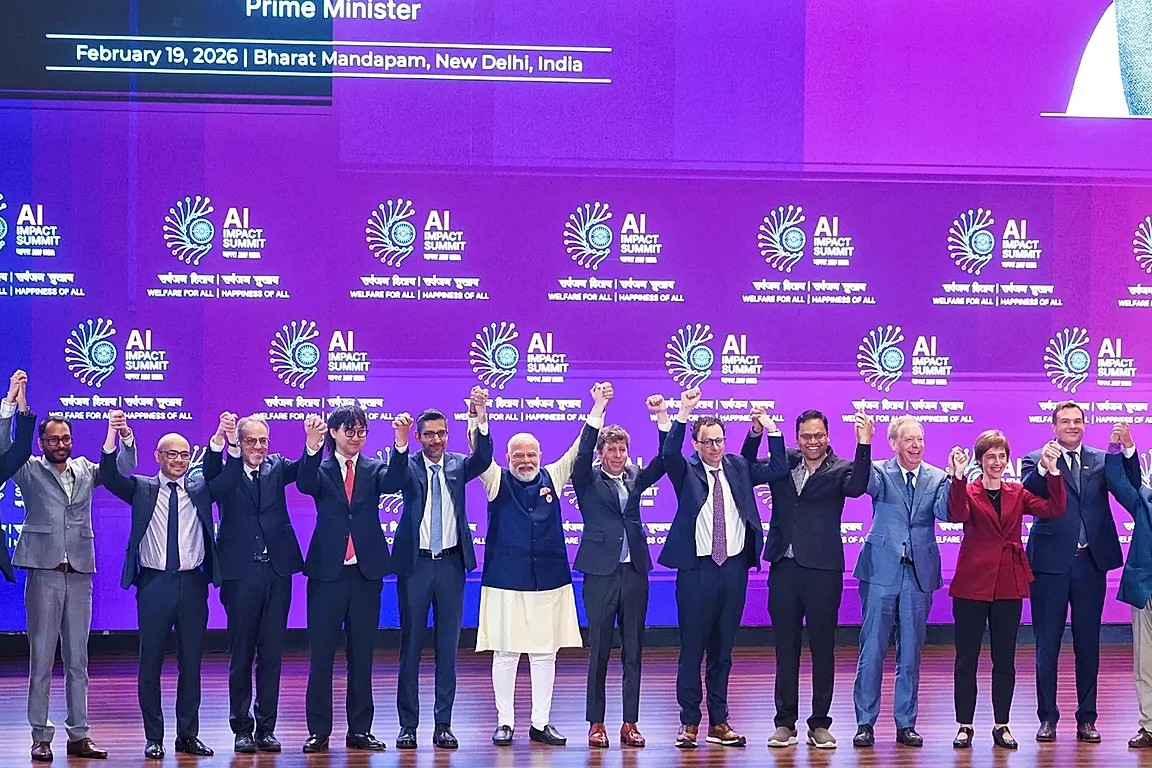
India’s AI Impact Summit 2026 in New Delhi showcased the country’s ambition to compete in the global artificial intelligence race dominated by the US and China (16/02–22/02). The event highlighted both India’s drive to innovate and its limitations in infrastructure and dependence on foreign technology.
Operational challenges, including accreditation glitches, last-minute schedule changes, restricted VIP movement, long queues, and traffic jams, affected participants’ experience. An Indian university was removed from the summit after one of its officials falsely claimed a Chinese-made robotic dog as its own invention (16/02).
“The whole intent and purpose was to really put on display India’s seriousness in the field of AI,” said Rentala Chandrashekhar, chairman of the Centre for the Digital Future. He added that India aims to develop technology and products and apply AI to tackle larger economic and human development problems.
Multi-Billion Dollar Investments Signal India’s AI Push
The summit announced deals worth billions of dollars, signaling a serious AI commitment. Tata Group will give several thousand employees access to ChatGPT’s enterprise version, and OpenAI will partner with Tata to build AI data centers in India.
Reliance Industries chairman Mukesh Ambani pledged US$110 billion over the next seven years to expand AI and data infrastructure. Adani Enterprises plans to invest US$100 billion to create renewable-powered, AI-ready data centers by 2035. Infosys partnered with US-based Anthropic to provide AI solutions across telecom, financial services, manufacturing, and software sectors.
Nvidia also announced collaborations with three Indian cloud providers to supply advanced processors for AI data centers. Former minister Rajeev Chandrasekhar noted, “The capacity and capability that exist in the Indian research and innovation ecosystems are solid,” while acknowledging that India will need to catch up with the US and China.
Startups and Data Power India’s AI Potential
India is ChatGPT’s second-largest market, with 100 million weekly users. Startup Sarvam AI launched two models trained on local datasets to provide generative AI tools tailored to Indian languages and culture.
“The power in India is the population and the amount of data that you can drive to train AI models,” said Vanessa Smith, chief corporate affairs officer at ServiceNow. Experts highlighted that India’s IT services expertise can support AI applications that can also be exported to countries in the Global South. Prime Minister Narendra Modi stated, “Any AI model that succeeds in India can be deployed anywhere in the world.”
Strategic Autonomy Amid US-China Tech Rivalry
The summit emphasized including perspectives from the Global South in an AI space dominated by the US and China. Professor Harsh V Pant, vice-president at the Observer Research Foundation, said AI must be inclusive and democratic to avoid replicating previous technological divides.
India remains dependent on foreign AI technology, software, and processors. Joining the US-led Pax Silica initiative aims to strengthen supply chains for critical minerals and AI. Sriram Krishnan, senior White House policy adviser on AI, stated that while Indian companies can localize applications, “at the end of the day, we want the American AI stack to be the bedrock that everyone builds on.”
Infrastructure Challenges Loom Large
India faces infrastructure challenges to meet AI ambitions. Data centers require large amounts of energy and water. Vivek Agarwal, country director at the Tony Blair Institute, said India is meeting current energy needs but noted that powering AI centers will demand significant resources. He highlighted nuclear energy efforts as a key step toward meeting these requirements.
The summit brought together private sector leaders, academics, and government officials from advanced and developing countries, giving India a stronger voice in global AI discussions. Agarwal said, “The US is the frontrunner with Nvidia and others; China will probably catch up soon. The third country to do that will likely be India. And nobody in the government or otherwise will disagree that it will take a lot of effort.”
PHOTO: INDIAN PRIME MINISTER'S OFFICE/AP
This article was created with AI assistance.
We make every effort to ensure the accuracy of our content, some information may be incorrect or outdated. Please let us know of any corrections at [email protected].
Read More