





 Saturday, 24-10-26








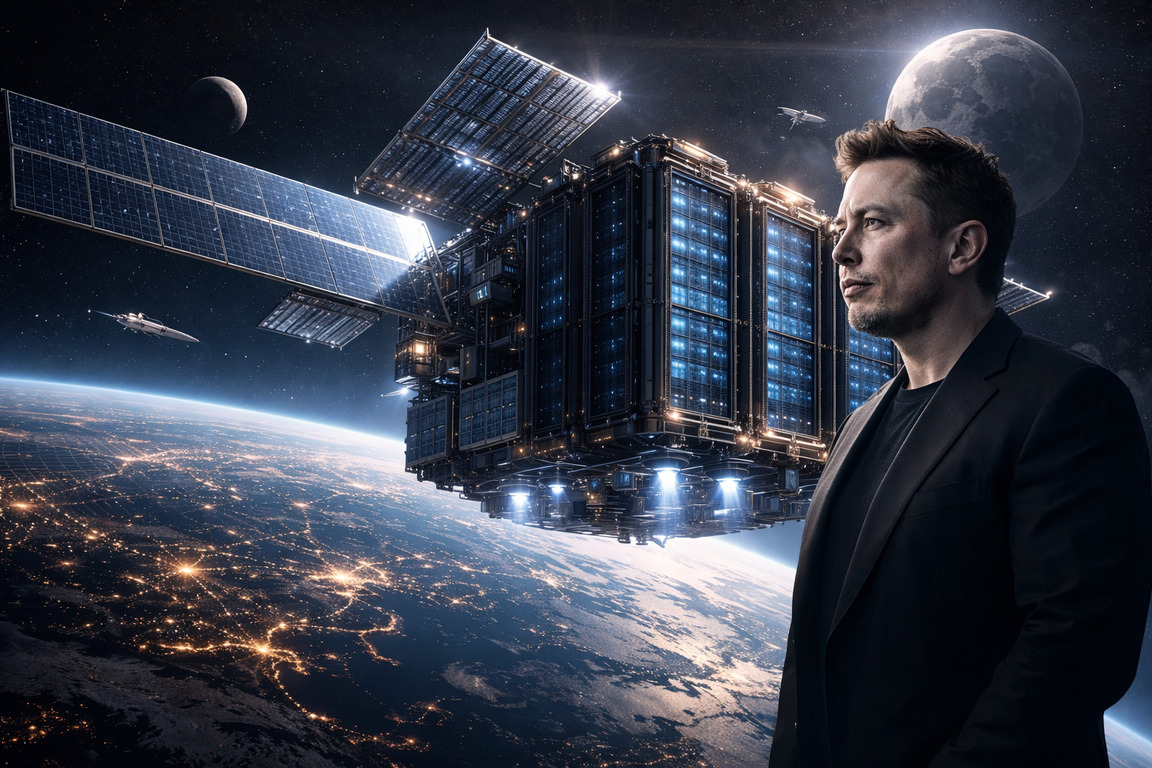
When Elon Musk began floating the idea of putting AI data centers in orbit, critics dismissed it as science fiction. But beneath the spectacle lies a serious strategic thesis: artificial intelligence is colliding with the physical limits of Earth’s energy infrastructure. If compute is the new oil, power is the new bottleneck — and Musk appears to believe that space may become the next industrial zone for AI.
Drawing on reporting from Reuters, Wired, Fortune, and The New York Times, this article examines one central angle:
Musk’s space-based data center vision is not about novelty — it is a radical response to AI’s escalating energy economics.
The real question is not whether we can put servers in space. It is whether terrestrial infrastructure can sustain AI’s exponential growth without triggering economic and environmental strain.
The Core Constraint: AI’s Exploding Energy Demand
AI’s infrastructure build-out is unlike anything the tech sector has experienced before.
Training frontier models requires tens of thousands of GPUs running in parallel for weeks. Inference workloads — once considered lighter — are now persistent, global, and increasingly multimodal. According to industry estimates cited by Fortune, hyperscale AI data centers can consume 100 to 300 megawatts (MW) each — equivalent to powering 80,000 to 250,000 homes.
In the United States alone, data centers accounted for roughly 4–5% of national electricity consumption in 2024, and projections suggest that AI growth could push that figure above 8–10% by the early 2030s.
This surge is creating multiple bottlenecks:
- Grid capacity limitations – Utilities in states like Virginia and Texas have warned of strained transmission networks.
- Water usage pressures – Advanced cooling systems consume millions of gallons annually.
- Permitting and local opposition – Communities increasingly resist large AI campuses.
- Carbon accounting challenges – Even renewable-powered centers rely on grid balancing from fossil fuels.
As reported by Reuters, Musk’s thesis is straightforward: Earth’s energy system may not scale fast enough to meet AI’s ambitions.
The Strategic Logic: Why Space?
The argument for orbital data centers rests on three physical premises.
1. Continuous Solar Energy
In low Earth orbit (LEO), solar panels can receive near-constant sunlight, except during brief orbital eclipses. Solar irradiance in space averages around 1,361 watts per square meter, without atmospheric attenuation.
On Earth, solar farms experience:
- Night cycles
- Cloud variability
- Atmospheric scattering
- Land constraints
In theory, a satellite-based compute platform could operate with higher solar utilization rates than terrestrial equivalents.
2. Decoupling from Terrestrial Grids
AI data centers on Earth must connect to national grids. Large facilities often require years of infrastructure upgrades before activation.
Space-based facilities would:
- Generate power independently.
- Avoid grid congestion.
- Bypass local permitting disputes.
This is particularly strategic for Musk, whose aerospace company SpaceX already operates thousands of satellites through Starlink. Vertical integration could reduce launch and deployment costs relative to competitors.
3. Heat Dissipation - The Controversial Claim
Proponents argue that space’s vacuum allows direct radiative cooling. However, as Wired notes, radiation is slower and less efficient than convection-based cooling systems on Earth. Thermal management in orbit requires large radiator panels — adding mass, cost, and engineering complexity.
This is where the physics collides with economic reality.
The Economics: Launch Costs vs Energy Savings
The fundamental economic tradeoff is stark.
Launch Costs
Even with reusable rockets, launch expenses remain substantial. Estimates suggest:
- $1,500–$2,500 per kilogram to LEO for commercial payloads.
- A single high-density AI server rack can weigh several hundred kilograms.
- A meaningful AI compute cluster would require thousands of such units.
At current costs, deploying even a modest orbital data center could run into billions of dollars before accounting for maintenance or replacement cycles.
Musk’s implicit bet is that launch costs will continue falling, potentially below $500/kg with next-generation heavy-lift vehicles.
Hardware Replacement and Radiation
GPUs are not designed for prolonged radiation exposure. Space-grade electronics typically lag consumer silicon by generations due to hardening requirements.
As reported in multiple outlets, critics including Sam Altman of OpenAI have labeled the concept premature, arguing that failure rates and replacement logistics would negate theoretical advantages.
Replacing malfunctioning orbital GPUs is not as simple as dispatching a technician. Every hardware refresh becomes a launch mission.
The Competitive Context: An Emerging AI Infrastructure Arms Race
Musk is not operating in isolation.
China has outlined ambitions for space-based digital infrastructure. Several startups have proposed orbital solar stations. Technology firms are racing to secure renewable energy contracts for terrestrial AI campuses.
The convergence of AI and space represents a geopolitical layer:
- Control of orbital compute nodes could become strategic.
- Nations may view space-based AI as sovereign infrastructure.
- Regulatory frameworks for orbital industrialization remain immature.
By linking his AI company xAI with SpaceX — recently consolidated in reporting by major outlets — Musk is creating a vertically integrated stack: launch, satellite manufacturing, communications, and AI compute.
This mirrors his earlier playbook in electric vehicles and rocketry: collapse supply chains under one corporate umbrella.
Environmental Calculus: Climate Savior or Orbital Risk?
One of the strongest narratives supporting space data centers is climate mitigation.
Terrestrial AI facilities:
- Consume vast electricity.
- Strain water resources.
- Require large land footprints.
Space-based centers could theoretically:
- Operate on direct solar power.
- Eliminate water cooling.
- Reduce local environmental impact.
However, this shifts the externalities rather than eliminating them.
Concerns include:
- Space debris proliferation.
- Orbital congestion (over 9,000 active satellites currently in LEO).
- Collision risks that could trigger cascading debris events.
Moreover, rocket launches themselves carry carbon and particulate emissions.
The net environmental impact remains unquantified — and likely highly sensitive to scale.
Time Horizons: Vision vs Reality
Musk has reportedly suggested that space could become one of the cheapest places to run AI within a few years. Most analysts disagree.
Industry experts cited by Fortune and Reuters indicate:
- Near-term deployments would likely be experimental or niche.
- Hyperscale AI workloads will remain Earth-based through the 2030s.
- Launch economics must improve dramatically before parity is plausible.
Historically, transformative infrastructure shifts — railroads, fiber optics, undersea cables — took decades from concept to dominance.
Orbital data centers may follow a similar arc.
The Deeper Angle: AI’s Industrialization Phase
What makes this proposal significant is not its feasibility today, but what it signals about AI’s industrial maturity.
AI is no longer just software. It is:
- Energy-intensive.
- Capital-intensive.
- Infrastructure-dependent.
- Geopolitically sensitive.
When computing demand pushes beyond planetary constraints, the conversation shifts from algorithms to megawatts.
Musk’s proposal reframes AI as a heavy industry, comparable to steel or oil refining, rather than cloud software.
That reframing matters.
It forces policymakers and investors to confront a central question:
If AI becomes a foundational layer of the global economy, where should its physical backbone reside?
On Earth, constrained by politics and grids?
Or in orbit, constrained by physics and economics?
Investment Implications
If even partially realized, space-based compute would create ripple effects across sectors:
- Aerospace manufacturing
- Radiation-hardened semiconductor design
- Orbital robotics and maintenance
- Space traffic management
- Solar panel efficiency technologies
Capital markets may begin pricing optionality into companies positioned at the AI-space intersection.
Even if orbital data centers never achieve cost leadership, early experimentation could generate adjacent innovations in energy efficiency and modular compute architecture.
Conclusion: A Hedge Against Earth’s Limits
Elon Musk’s orbital data center vision may sound audacious, but it reflects a rational response to an uncomfortable trend: AI growth is testing the limits of terrestrial infrastructure.
Today, the economics do not justify large-scale deployment in space. Launch costs remain high. Thermal management remains complex. Hardware durability remains uncertain.
But if three variables shift simultaneously:
- Launch costs fall below $500/kg,
- Solar panel efficiency improves significantly,
- AI energy demand continues doubling every few years,
then the equation changes.
In that future, space is not a vanity project. It becomes an industrial extension of Earth.
For now, Musk’s proposal sits at the frontier, improbable but not impossible. And in technology history, frontiers are often where the next era quietly begins.
Read More