





 Friday, 19-06-26








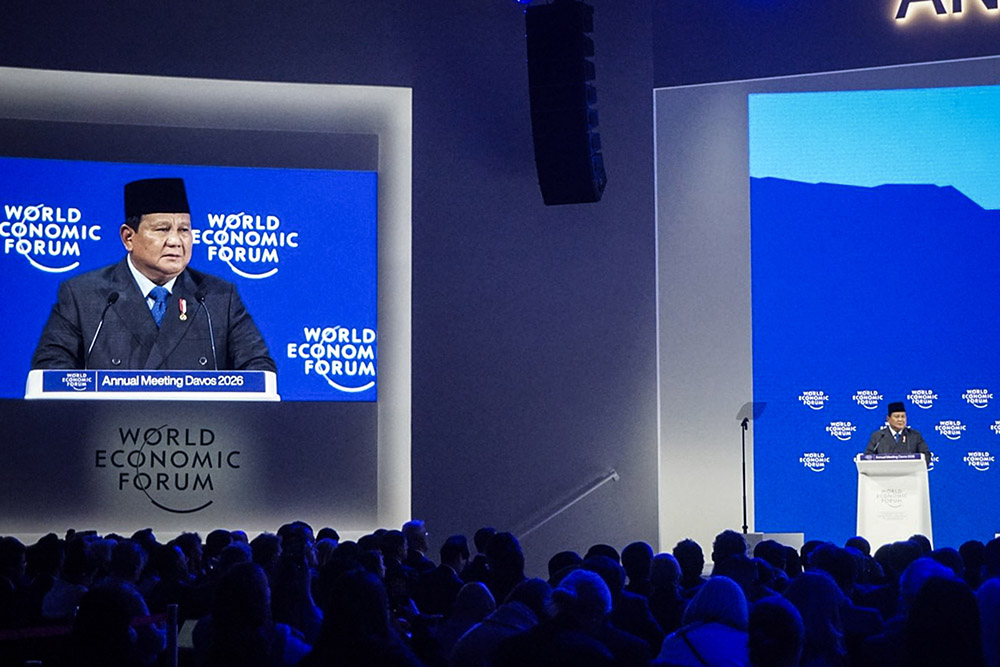
At the World Economic Forum 2026 (WEF) in Davos, Switzerland, Indonesian President Prabowo Subianto delivered a comprehensive address focusing on the resilience and stability of Indonesia’s economy in the face of global uncertainty. His remarks highlighted how Indonesian economic stability at WEF has positioned the country as a credible and resilient economy on the world stage, even amid tightening global financial conditions, geopolitical tensions, and ongoing trade disruptions. Prabowo’s speech underscored the central role that peace, data-based economic policy, and disciplined fiscal management play in sustaining growth and attracting long-term investment confidence.
The World Economic Forum Annual Meeting 2026, themed “A Spirit of Dialogue,” convened global leaders from politics, business, and civil society to discuss major economic, social, and geopolitical challenges. Prabowo’s participation marked a significant moment for Indonesia’s global economic representation, reaffirming the government’s approach to maintaining economic stability as a strategic foundation for growth and prosperity.
Peace and Policy Discipline as Pillars of Stability
A central message from Prabowo’s address was the assertion that peace and political stability are essential prerequisites for sustainable economic growth. He emphasized that Indonesian economic stability at WEF is rooted in longstanding national unity, collaborative governance, and a deliberate choice of friendship over division both domestically and internationally. According to Prabowo, peace and stability are not accidental but the result of consistent national choices that enable effective policymaking and economic planning.
Prabowo stated that history demonstrates peace and stability as indispensable for prosperity. He noted that Indonesia’s disciplined economic management and united political environment have created an environment conducive to investment and growth. He argued that prosperity cannot be divorced from peace, especially when global circumstances are marked by conflict and weakening trust among nations.
The emphasis on peace and stability addressed a core investor concern: the linkage between political certainty and economic performance. By framing peace as a prerequisite to economic success, Prabowo reinforced Indonesia’s image as a reliable destination for foreign direct investment and long-term strategic partnerships.
Economic Performance and International Recognition
Prabowo’s remarks at the forum also highlighted Indonesia’s recent macroeconomic performance. He reiterated that the country’s economy has consistently grown by more than 5 percent annually over the past decade, despite global headwinds such as trade tensions, financial tightening, and political uncertainty. He forecasted that growth in 2026 would exceed past performance, citing robust fundamentals and well-calibrated policy frameworks.
In his speech, Prabowo referenced assessments from international financial institutions, including the International Monetary Fund (IMF), which described Indonesia as a “global bright spot” amid challenging global conditions. This recognition stems not from optimistic projections alone but from measurable economic performance indicators, such as controlled inflation and balanced fiscal management.
Inflation in Indonesia has reportedly remained stable at around two percent, while the government budget deficit has been maintained below three percent of GDP. These figures were highlighted as evidence of prudent fiscal policy and credible economic governance, reinforcing the narrative of Indonesian economic stability at WEF as more than rhetorical but tangible.
Policy Design: Data-Driven and Calibrated Approaches
Another key aspect of Prabowo’s address focused on the design and implementation of Indonesia’s economic policies. He emphasized that these policies are intentionally measured, data-driven, and well-calibrated to respond to both domestic and external pressures. The strategic use of data and evidence in policy formulation was presented as a key factor in sustaining national resilience and economic stability.
Prabowo argued that the nation’s credibility in economic and fiscal management is the result of a consistent commitment to disciplined governance. He pointed out that Indonesia has never defaulted on its sovereign debt obligations, highlighting a track record of honoring financial commitments across successive administrations. This continuity and predictability in governance are critical for building investor confidence and reinforcing global perceptions of Indonesian economic stability at WEF.
Such emphasis on fiscal discipline reinforces Indonesia’s strategic positioning as a growth economy with macroeconomic indicators that align with long-term investor expectations, particularly amid a context of tightening global financial conditions. Maintaining fiscal discipline also helps buffer the economy against external shocks and supports sustainable public investment without compromising stability.
Strategic Institutional Developments
While economic stability remained the central theme, Prabowo also referenced broader institutional developments that reinforce Indonesia’s economic role on the global stage. One such development is the establishment and role of the sovereign wealth fund Danantara. This entity, which manages significant assets, has been described by the president as a platform that enables Indonesia to participate as an equal partner with global investors and institutions.
Danantara represents a strategic institutional mechanism designed to channel investment into future-oriented industries and national priorities, potentially accelerating economic transformation and diversification. Its inclusion in the WEF discourse introduced a dimension of long-term strategic vision beyond routine economic metrics, positioning Indonesia as a proactive partner in global investment networks.
Development Beyond Macroeconomics
Prabowo’s address at the WEF also touched upon elements that extend beyond traditional macroeconomic indicators. He highlighted ongoing government initiatives to enhance human capital development and education, which he argued are fundamental to sustained inclusive growth. Investments in education technology and school modernization reflect a broader strategy of bolstering long-term productive capacity and competitiveness, which further supports the narrative of economic stability tied to structural development.
Emphasizing human resource development at a forum of global economic policymakers signals Indonesia’s intention to align domestic social priorities with international expectations for future-ready economies.
Global Trade and Integration
Prabowo’s address also touched on trade integration and Indonesia’s openness to engage with global markets. He underscored that fair and mutually beneficial trade should not be perceived as a threat to national sovereignty but as a tool for shared prosperity. This perspective aligns with broader global economic discussions at the WEF, where trade dynamics remain central to addressing global growth challenges and economic fragmentation trends.
By advocating trade integration alongside stable policy environments and peace, Prabowo projected an integrated economic strategy that balances domestic priorities with global cooperation.
Imperatives for International Investors
For the international investor community, Prabowo’s framing of Indonesian economic stability at WEF provides several clear takeaways. First, it signals that Indonesia is committed to policy continuity and fiscal discipline even amid global uncertainty. Second, by emphasizing calibrated, data-led governance and political stability, Indonesia presents itself as a lower-risk market relative to more volatile emerging economies. Third, the strategic development of institutions such as Danantara positions Indonesia as a co-investor rather than a passive recipient of capital.
These elements combined paint a picture of Indonesia as a credible, resilient, and forward-thinking economy at a time when global investors increasingly seek markets with predictable growth trajectories and sound governance frameworks.
Conclusion: Stability as a Foundation for Growth
In his World Economic Forum 2026 address, President Prabowo Subianto articulated a multifaceted vision that places Indonesian economic stability at WEF at the heart of the nation’s growth narrative. By linking peace, disciplined policy, data-driven governance, and credible fiscal management, he outlined a comprehensive framework that supports economic resilience, attracts investment, and sustains inclusive growth.
This strategic positioning, buttressed by consistent macroeconomic performance and intentional policy design, reinforces Indonesia’s role as a stable emerging market leader within the global economic landscape. As geopolitical and financial uncertainties persist, stability and credibility remain critical determinants of long-term economic success.
Read More