





 Monday, 12-10-26








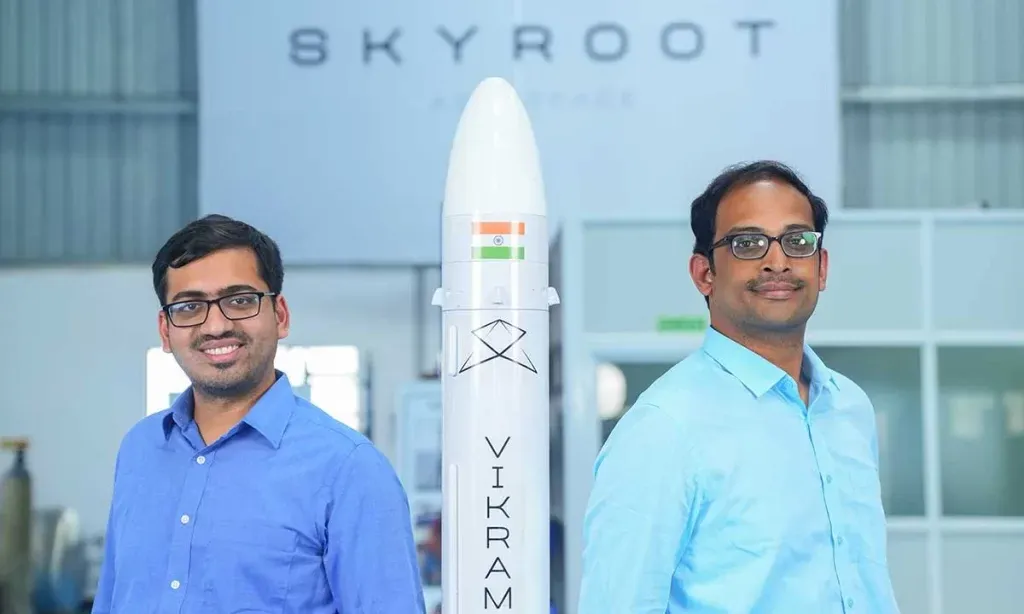
India’s space sector is undergoing a profound transformation, shifting from a government dominated ecosystem to a vibrant commercial landscape powered by innovation, private capital, and entrepreneurial ambition. At the heart of this transition are Indian space tech startups, which are increasingly playing a critical role in satellite manufacturing, launch services, propulsion systems, and sustainable space missions. According to industry projections, India’s aerospace and space economy is expected to reach USD 54.4 billion by 2033, positioning the country as a major global space hub.
This rapid expansion is being driven not only by policy reforms and institutional support from the Indian Space Research Organisation, but also by a new generation of startups that are commercializing space technologies once reserved for national agencies. These companies are addressing critical gaps in satellite deployment, space sustainability, and cost efficiency, while enabling India to compete with established space economies such as the United States, Europe, and China.
The Rise of Indian Space Tech Startups
For decades, India’s space ambitions were largely spearheaded by ISRO, whose achievements in satellite launches, interplanetary missions, and cost effective engineering earned global recognition. However, the opening of the space sector to private players marked a turning point. Regulatory reforms, including the creation of IN SPACe and a clearer private participation framework, catalyzed the rise of Indian space tech startups.
These startups are not merely service providers but innovation drivers. They focus on developing proprietary technologies in areas such as satellite propulsion, earth observation payloads, launch vehicles, and orbital sustainability. By reducing costs and improving reliability, they are making space access more affordable for commercial clients, research institutions, and international partners.
The emergence of Indian space tech startups has also aligned with rising global demand for satellite based services, including broadband connectivity, climate monitoring, defense surveillance, and disaster management. As satellite constellations grow and space becomes more congested, innovation in propulsion, debris mitigation, and mission efficiency has become essential.
Startups Powering Satellite Technology And Sustainable Missions
One of the defining features of India’s new space ecosystem is the focus on sustainability. Unlike earlier eras of space exploration that prioritized scale over environmental impact, modern Indian space tech startups are designing solutions that reduce orbital debris, extend satellite lifespan, and minimize mission waste.
Several startups highlighted in the ecosystem are working on advanced propulsion systems that use green propellants, enabling satellites to maneuver more efficiently while lowering environmental risks. These propulsion innovations are crucial for maintaining satellite orbits, avoiding collisions, and enabling controlled deorbiting at the end of mission life.
Satellite manufacturing startups are also adopting modular and lightweight designs, allowing operators to deploy payloads faster and at lower cost. This approach is particularly attractive for small satellite operators and emerging markets that require flexible and scalable solutions.
In addition, Indian space tech startups are contributing to earth observation missions that support agriculture, urban planning, climate resilience, and infrastructure monitoring. High resolution imaging satellites and data analytics platforms developed by these companies are helping governments and enterprises make more informed decisions using space derived insights.
Economic Impact And Aerospace Market Growth
The projected growth of India’s aerospace market to USD 54.4 billion by 2033 underscores the economic significance of the space startup ecosystem. Indian space tech startups are expected to play a central role in this expansion by creating high value jobs, attracting foreign investment, and generating export revenue.
Unlike traditional aerospace manufacturing, space tech startups operate at the intersection of software, hardware, and data services. This convergence enables faster innovation cycles and higher scalability. Startups can monetize not only physical satellites and launch services but also recurring data subscriptions and analytics platforms.
The growth of Indian space tech startups is also strengthening India’s position in global supply chains. As international space companies seek cost effective partners, Indian startups are emerging as credible suppliers of components, subsystems, and mission services. This integration into global markets further accelerates technology transfer and skill development within the domestic ecosystem.
Moreover, venture capital and strategic investors are increasingly viewing space technology as a long term growth sector rather than a niche domain. The influx of funding has allowed startups to invest in research, testing infrastructure, and talent acquisition, reinforcing the overall competitiveness of India’s space industry.
Government Support And Policy Enablement
The success of Indian space tech startups is closely linked to supportive government policies. Initiatives such as the Indian Space Policy and the establishment of IN SPACe have created a more predictable regulatory environment, enabling startups to collaborate with ISRO while retaining commercial independence.
Access to launch infrastructure, testing facilities, and satellite data has significantly reduced entry barriers. This collaborative model allows startups to leverage decades of institutional expertise while introducing private sector agility and market driven innovation.
Public procurement has also emerged as an important growth driver. By acting as an anchor customer, government agencies provide early revenue opportunities that help startups validate their technologies and scale operations. Over time, this demand led model supports sustainable business growth and reduces reliance on speculative funding.
Challenges Facing Indian Space Tech Startups
Despite rapid progress, Indian space tech startups face several structural challenges. High capital requirements, long development cycles, and stringent reliability standards make space ventures inherently risky. Unlike consumer technology startups, failures in space missions can be costly and reputationally damaging.
Talent acquisition is another constraint. Space technology requires highly specialized skills in aerospace engineering, materials science, and systems integration. While India has a strong engineering base, competition for experienced professionals remains intense.
Additionally, global competition is intensifying. Established players from the United States and Europe benefit from deeper capital pools and mature commercial markets. Indian startups must therefore differentiate through cost efficiency, customization, and niche specialization.
Addressing these challenges will require continued policy support, patient capital, and stronger collaboration between academia, industry, and government institutions.
India’s Position In The Global Space Economy
The rise of Indian space tech startups signals a broader shift in the global space economy. Space is no longer the exclusive domain of superpowers. Emerging space nations with strong innovation ecosystems can now compete by offering agile, cost effective, and sustainable solutions.
India’s advantage lies in its proven engineering excellence, competitive cost structure, and growing domestic demand for satellite services. By nurturing startups that focus on both upstream and downstream space activities, India is building a balanced and resilient space ecosystem.
As global demand for satellite connectivity and earth observation continues to grow, Indian space tech startups are well positioned to capture a meaningful share of international markets. Their success will not only contribute to economic growth but also reinforce India’s strategic autonomy in space.
Conclusion
The momentum behind Indian space tech startups reflects a fundamental transformation in how India approaches space innovation. From satellite propulsion and sustainable missions to data driven earth observation, these startups are redefining the country’s role in the global aerospace industry. With the Indian aerospace market projected to reach USD 54.4 billion by 2033, the contributions of private innovators will be critical in shaping this growth trajectory.
As policy support strengthens and commercial opportunities expand, Indian space tech startups are poised to become long term pillars of the national economy. Their ability to blend technological excellence with commercial viability will determine how far India can go in establishing itself as a global space powerhouse.
Read More