





 Monday, 12-10-26








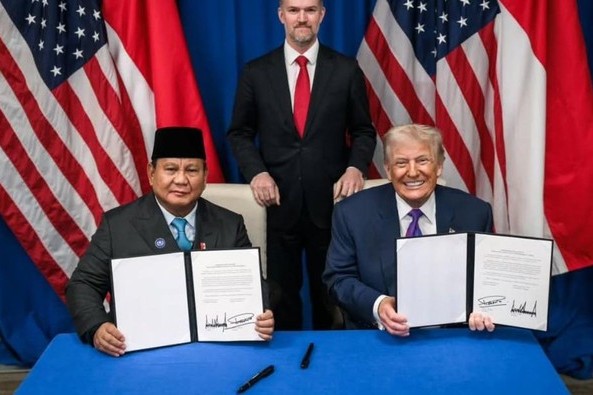
US President Donald Trump and Indonesian President Prabowo Subianto finalized a major trade agreement on 19/02, ending months of uncertainty. The deal reduces US tariffs on most Indonesian goods from a threatened 32% to 19% and eliminates higher duties on palm oil, spices, and pharmaceuticals.
The agreement allows certain textiles and apparel to qualify for tariff exemptions, supporting a key Indonesian industry. The White House said the leaders “confirmed their strong commitment to implementing” the deal and instructed teams to “take further steps for a NEW GOLDEN AGE of the ever-growing US-Indonesian Alliance.”
Indonesia to Purchase $33 Billion in US Goods.
As part of the deal, Indonesia will purchase about US$33 billion in American goods. This includes US$15 billion in energy products: US$3.5 billion of liquefied petroleum gas, US$4.5 billion of crude oil, and US$7 billion of refined petrol.
Indonesia will also import US$13.5 billion in commercial aircraft and US$4.5 billion in agricultural products, including cotton, soybeans, wheat, beef, rice, and corn. These purchases aim to reduce Indonesia’s roughly US$16 billion trade surplus with the US.
Reforms to Pre-Shipment Inspections and Digital Service Tariffs
The agreement includes reforms to Indonesia’s pre-shipment inspection processes to address US exporters’ concerns. Indonesia will remove tariffs and fees on digital services and eliminate non-tariff barriers, improving access for American companies.
US Trade Representative Jamieson Greer said, “President Trump is unlocking Indonesia’s market of over 285 million people to create commercially meaningful opportunities for American farmers and manufacturers.”
Critical Minerals and Supply Chain Cooperation
The pact also covers critical minerals. Indonesia will allow US companies to extract minerals on terms similar to domestic investors, while the US may provide financing through the Export-Import Bank and the US International Development Finance Corporation.
These measures support the US strategy to reduce reliance on China for critical minerals used in electric vehicles, defence, and manufacturing, while maintaining trade relations between the two countries, whose bilateral trade exceeds US$40 billion annually.
PHOTO: INSTAGRAM/SESKAB/DETIK.COM
This article was created with AI assistance.
We make every effort to ensure the accuracy of our content, some information may be incorrect or outdated. Please let us know of any corrections at [email protected].
Read More