





 Saturday, 24-10-26








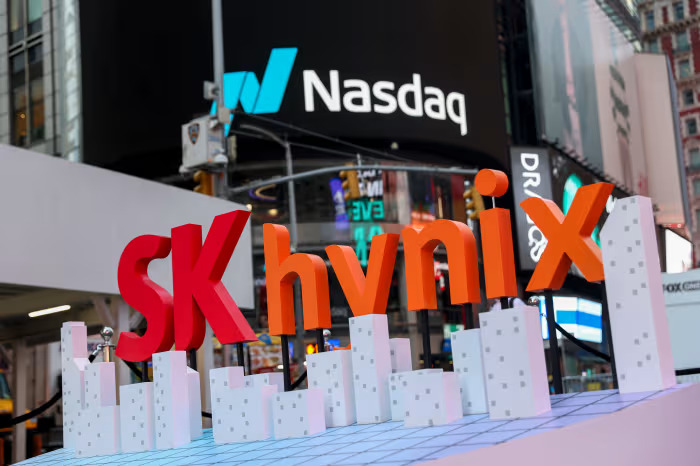
SK Hynix’s latest market move is a reminder that even the strongest stock rallies can reverse fast. After a blockbuster Nasdaq debut that raised about $26.5 billion and initially sent its U.S.-listed shares sharply higher, the South Korean chipmaker saw its local shares slide more than 15% in Seoul, the biggest one-day decline on record, as investors locked in gains. The selloff also dragged down the Kospi index and triggered a temporary trading halt, showing how closely one heavyweight stock can influence the broader market.
For investors searching for why SK Hynix shares fall, the answer is not a mystery. It is a mix of profit taking, stretched expectations, and short-term nerves after an extraordinary run. Yet the bigger story is more nuanced. The company remains deeply tied to the global AI supply chain, and its latest listing was meant to strengthen funding, visibility, and long-term strategic positioning. That makes this pullback less like a collapse and more like a sharp recalibration after a surge.
A Red-Hot Rally Meets A Hard Reality Check
The first major clue in understanding why SK Hynix shares fall is timing. Reuters reported that the company raised over $26 billion by selling American Depositary Receipts at $149 each, with the ADRs opening 14% above the offer price at $170 and ending their first session up 12.8%. That kind of debut naturally attracts momentum buyers, but it can also invite fast profit taking once the excitement fades. The company’s Korean shares had already more than tripled this year, leaving many holders with substantial gains to protect.
The reversal was especially violent because SK Hynix has become one of the clearest beneficiaries of the AI memory boom. When a stock rises that far, that quickly, the market often starts to debate whether future earnings can keep pace with valuation. In this case, investors were not only reacting to the listing itself. They were also reassessing how much upside was still left after a long period of enthusiasm around high-bandwidth memory, AI data centers, and semiconductor demand.
Why Investors Took Profits So Quickly
There is a practical reason why SK Hynix shares fall after such a successful debut. Big events often create a classic buy-the-rumor, sell-the-news pattern. Ahead of the listing, demand was reportedly more than seven times available shares, and the company’s U.S. offering was described as a major play to tap the world’s deepest pool of investors. Once the listing was complete and the immediate price discovery was over, some investors chose to cash out instead of waiting for the next leg higher.
That profit-taking was reinforced by caution around earnings. A Reuters-cited analyst said investors had expected shipments of HBM4 chips to rise from the second quarter, but that the increase did not appear to have materialized at scale. Another concern was that SK Hynix, because of its heavier exposure to the HBM market, may benefit less than some peers from a recent rise in conventional DRAM prices. In other words, the market was asking whether the company’s near-term earnings momentum could justify the pace of the share-price surge.
There was also a broader liquidity story. SK Hynix’s U.S. ADRs traded at a sizeable premium to the Seoul-listed shares after the rout, which Reuters said reflected the usual premium that comes with broader investor access and deeper liquidity in the U.S. market. That gap can create pressure on the home-market shares when arbitrage is limited, especially if investors can more easily trade the U.S. line than convert local shares into ADRs.
The AI Memory Trade Is Still The Core Story
Anyone trying to understand why SK Hynix shares fall should not ignore the fact that the company remains central to the AI hardware cycle. Reuters noted that SK Hynix led the high-bandwidth memory market with a 58% revenue share in the first quarter, ahead of Samsung and Micron, and that HBM chips are a critical component in AI systems used by customers such as Nvidia and Google. That is not a weak competitive position. It is the opposite. The company sits at the center of one of the market’s most important supply chains.
The issue is that the market had already priced in a lot of good news. Reuters reported that SK Hynix’s stock was up 680% over the prior 12 months, while its forward price-to-earnings ratio had fallen from 7.9 times at the end of October to 5.5 times, reflecting how quickly profits had caught up with valuation. That combination can look attractive to long-term investors, but it also means the stock is vulnerable to sharp swings whenever expectations shift even slightly.
Nvidia CEO Jensen Huang said last month that SK Hynix would continue to be Nvidia’s largest partner, and Reuters also cited a market forecast suggesting HBM demand could grow from about $65 billion this year to about $120 billion next year and roughly $290 billion by 2030. Those numbers help explain why the long-term case remains intact even after a sudden pullback. The market is not rejecting the AI memory thesis. It is simply reminding investors that a powerful theme can still produce volatile trading.
What The Nasdaq Listing Means For SK Hynix
The Nasdaq debut was never just about one day of trading. SK Hynix said in its filing that the ADSs were expected to begin trading on the Nasdaq Global Select Market on July 10, 2026, under the ticker SKHYV on a when-issued basis. Reuters reported that the company priced the ADRs at $149 and used the offering to raise about $26.5 billion, with proceeds intended to finance new factories and equipment for surging AI chip demand. That means the listing is part capital raise, part strategic repositioning.
The U.S. listing could also help narrow the valuation gap with Micron, another major memory supplier that enjoys easier access to U.S. capital markets. Reuters noted that SK Hynix has long traded at a lower valuation than some global peers, a pattern often linked to the so-called Korea discount, which refers to persistent concerns around governance and market structure. By adding a U.S. line, SK Hynix is trying to broaden its investor base and potentially improve how the market values its earnings power.
That said, the listing does not automatically guarantee a stronger local share price. Reuters quoted an analyst who said he did not expect the U.S. listing to produce a major boost to the Korean shares. That is important because the Seoul market’s reaction shows the difference between financial engineering and immediate sentiment. A better capital structure can help over time, but it cannot prevent traders from taking profits after a huge run.
What Investors Should Watch Next
The next phase for SK Hynix will depend on execution, not headlines. Investors will watch whether HBM4 shipments scale as expected, whether AI infrastructure spending stays strong, and whether the company can convert market leadership into sustained earnings growth. Those are the real variables behind the phrase SK Hynix shares fall. A one-day decline matters, but it matters most as a signal that expectations have become more demanding.
Near term, the stock may remain volatile because it has become a crowded trade for global investors who want exposure to AI memory. That can be a strength in a rising market, but it can also intensify moves on the downside when sentiment turns. Reuters described this volatility as being amplified by leveraged exchange-traded funds and speculative positioning, which can magnify both gains and losses. For active traders, that means the stock will probably continue to move more than the underlying business fundamentals might suggest on any given day.
For long-term investors, the more relevant question is whether SK Hynix can turn its leadership in high-bandwidth memory into durable earnings growth across a full cycle. The company’s first-quarter 58% revenue share in HBM, its central role in Nvidia’s AI supply chain, and its record capital raise all point to a business with rare strategic value. The recent drop does not erase that. It simply shows that even market leaders are not immune to sentiment resets after a major financing event.
Read More