





 Tuesday, 15-09-26








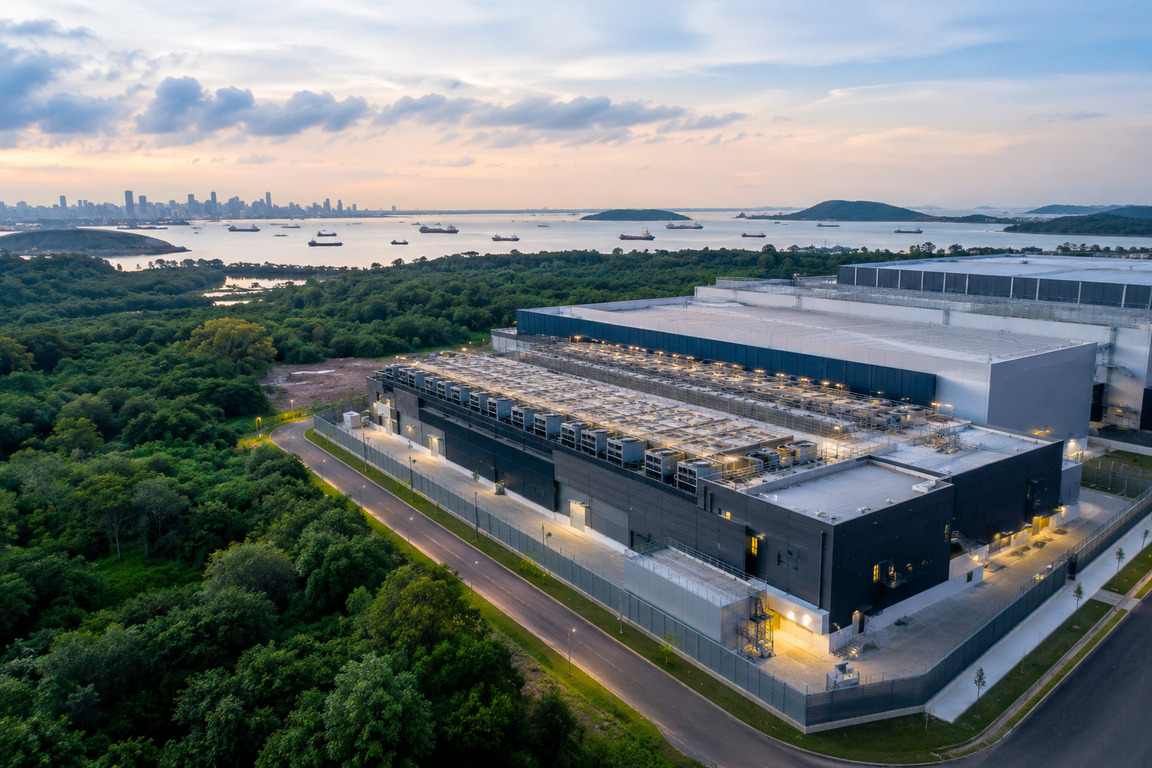
Batam’s rise as a data center location is no longer a speculative market story. In 2026, the island saw a series of concrete moves that now define the thesis: PLN Batam signed what it described as Indonesia’s largest data center electricity deal so far, a 511 MVA agreement, or roughly 450 MW, for DayOne’s hyperscale expansion in Kabil; a separate Batam project with Equator Gate System also moved forward; and Telkom said its NeutraDC Nxera Batam facility had already filled the first building’s capacity before launch and was preparing a second phase. At the same time, Oracle has been reported as weighing a Batam cloud-services investment, and Batam still benefits from its proximity to Singapore and its SEZ-linked digital ecosystem.
The Numbers Behind Batam’s Surge
The latest evidence suggests Batam is forming into a clustered hyperscale market rather than a one-off project site. Reuters reported in June 2025 that DayOne and the Indonesia Investment Authority secured a $411 million loan from DBS and UOB to build three data centers in Batam’s Nongsa Digital Park, with a combined capacity of about 72 MW, or roughly 5% of Indonesia’s projected 1.41 GW data center capacity by 2029. That financing matters because it showed international lenders already see Batam as bankable infrastructure, not just an experimental location.
The island’s appeal is structural. Singapore’s Economic Development Board describes Nongsa Digital Park as part of a Singapore-Indonesia tech park, located about a 40-minute ferry ride from Singapore, while Telkom says Batam’s case is strengthened by its location near Singapore and by 14 submarine cables connecting the region to Southeast Asia. In other words, Batam offers the combination that hyperscalers value most: low-latency proximity to a major digital hub, cross-border demand, and an industrial zone built for scale.
That proximity is being matched by repeated capacity announcements. Telkom said NeutraDC Nxera Batam’s first building starts at 18 MW and can scale to 54 MW, which is not hyperscale fantasy but a real, staged buildout. BP Batam also said the DayOne project in Kabil is the company’s second hyperscale campus in Batam. Together, those disclosures suggest Batam is moving from “one campus” economics to a platform model where multiple operators can share the same digital corridor.
Power is The Binding Constraint
The headline number that matters most is Batam’s own published utility snapshot. BP Batam’s infrastructure page says the city’s total electricity capacity is 538.95 MW and peak load is 475 MW, which leaves about 64 MW of theoretical headroom on the current published figures. That is a useful clue, because the latest DayOne agreement alone is described as about 450 MW of grid capacity. The inference is straightforward: Batam cannot support the current hyperscale pipeline on a static citywide grid; the island will need continuous expansion, dedicated supply arrangements, or both.
This is exactly the kind of environment where power has overtaken location as the key site-selection variable. Colliers’ 2026 Data Center Marketplace Report says power availability, delivery timing, and contractual certainty now drive feasibility more than geography, and that 40%–50% of total project costs can be tied to power infrastructure. Batam’s power story is therefore not just about whether the island has enough electricity today; it is about whether utilities can keep issuing credible, bankable commitments fast enough to satisfy hyperscale developers.
Water is the second test. BP Batam’s infrastructure page lists clean-water production capacity at 3,487 liters per second across six main reservoirs, while a March 2026 BP Batam update said it and PT ABH were working to increase supply capacity by 850 liters per second, taking total available supply from 4,429 to 4,710 liters per second and reinforcing pipelines in stressed areas. That is a meaningful upgrade, but it also shows that water management in Batam is already being treated as a pressure point, not a side issue. For data centers, especially in a humid tropical climate, that matters because cooling design, water reuse, and operational efficiency can become decisive cost and permitting variables.
Why Batam May Still Win the Race
Batam still has strategic advantages that are hard to copy quickly. The island sits inside the broader Batam-Bintan-Karimun economic corridor, and Singapore and Indonesia continue to deepen bilateral economic cooperation through the 6WG platform, which provides a policy backdrop for cross-border investment and infrastructure coordination. Even without a single “master plan” announcement, the direction of travel is clear: Batam is being treated as part of a regional digital and industrial supply chain, not just a local island economy.
The capital markets are validating that thesis. Reuters reported that the DayOne-INA Batam project received the largest rupiah-denominated data center loan in Indonesia to date, while Reuters also reported Oracle’s interest in Batam and Telkom’s effort to attract a strategic investor for its data center business. Put together, those deals show three layers of support: foreign lenders, global cloud interest, and domestic incumbents all betting that Batam can absorb more digital infrastructure if the utility side keeps pace.
The most important conclusion is that Batam’s data center boom is now an infrastructure story, not a real-estate story. The opportunity is real because demand is arriving in the form of signed PPAs, project finance, and phased campus construction. The risk is equally real because power margins are narrow and water upgrades are still in progress. If Batam can solve those two constraints faster than competing Southeast Asian sites, it can become Indonesia’s most important hyperscale hub outside Jakarta. If it cannot, the island may still grow, but at a slower pace and with more expensive infrastructure attached.
Read More