





 Thursday, 21-05-26








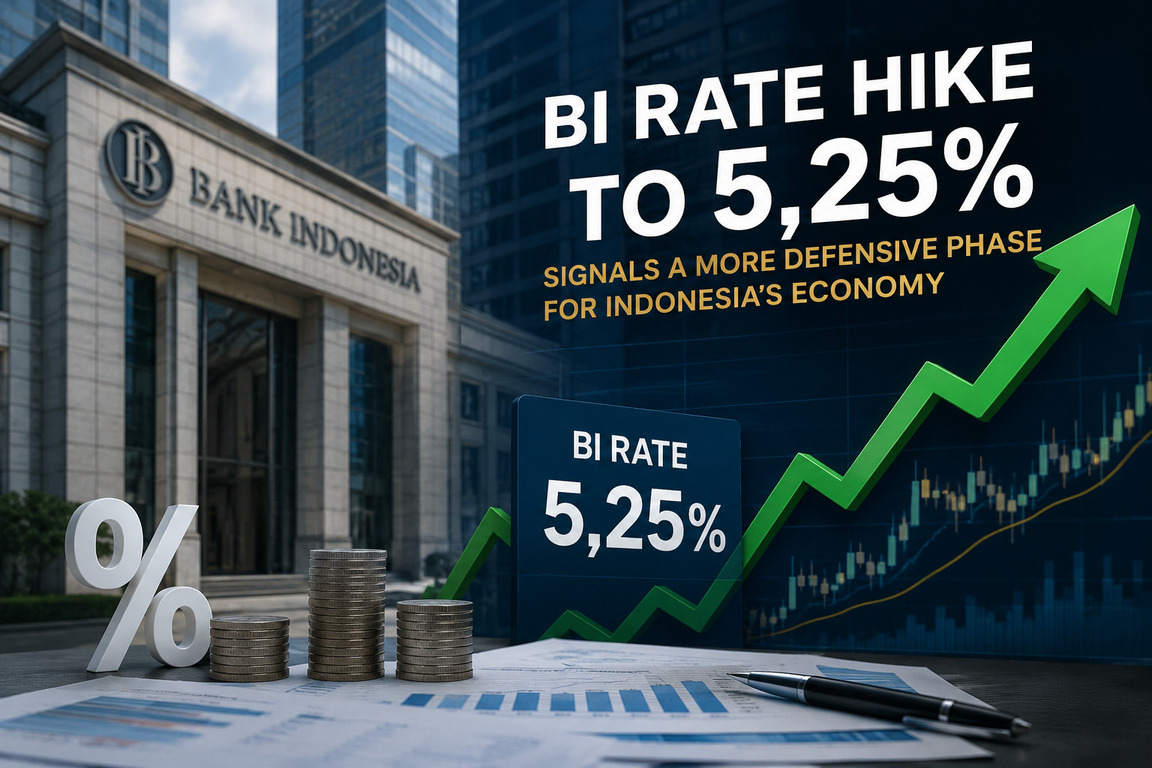
Bank Indonesia’s decision to raise the BI Rate by 50 basis points to 5.25% has pushed Indonesia into a more defensive monetary phase. The move was announced after the May 2026 Board of Governors meeting and came in line with market expectations on the headline rate, but the size and urgency of the increase still sent a clear message: currency stability now matters more than comfort. BI also lifted the deposit facility rate to 4.25% and the lending facility rate to 6%, underscoring that policy is being tightened across the corridor, not just at the benchmark.
The background to this decision is straightforward. The rupiah had been under sustained pressure despite BI’s repeated market interventions, including more frequent auctions and higher yields on rupiah securities. BI said the tighter stance is meant to protect the exchange rate from global volatility, especially the spillover from tensions in the Middle East, while keeping inflation in the official target range of 2.5% plus or minus 1% for 2026 and 2027. In other words, this was not simply a reaction to one weak trading session. It was a signal that the central bank sees a broader external shock that requires a stronger response.
The immediate market response was mixed but not surprising. The rupiah strengthened after the announcement and closed at Rp17,605 per US dollar, which suggests the market welcomed BI’s willingness to act more aggressively. Even so, the move did not fully erase the damage from earlier weakness, and the currency still remained far from the stronger levels seen previously. That is why this BI rate hike matters beyond the headline number. It is a confidence test for investors, importers, exporters, and households that are already sensitive to price changes and financing costs.
Why BI Chose A Sharper Move
The scale of the BI rate hike matters because it exceeded the market’s own internal benchmark. Bloomberg Technoz reported that expectations had been centered around a smaller move to 5%, yet BI went further and took the benchmark to 5.25%. That gap between expectation and decision matters in monetary policy because it changes how investors interpret the central bank’s tolerance for currency weakness. A standard move would have signaled caution. A 50 basis point increase signals determination.
From a policy perspective, BI is trying to re-anchor the rupiah before depreciation becomes self-reinforcing. When a currency weakens too far, imported inflation can rise, corporate hedging costs can climb, and consumers can eventually feel the pressure through higher prices for goods that rely on foreign inputs. BI’s own explanation makes clear that the goal is not to stimulate demand in the short term, but to stabilize the macro environment first. That is why the bank framed the move around external resilience and inflation control rather than growth support. This is a classic “stability first” posture, and the current BI rate hike fits that logic closely.
The broader reading is that BI is also defending its policy credibility. The second article suggests that the central bank had already used repeated interventions in the currency market and other support measures, but those steps were not enough to produce a durable turnaround in the rupiah. In that context, the rate hike functions as a stronger statement of intent. It tells the market that BI is prepared to accept some domestic pain, including higher borrowing costs, if that is necessary to preserve exchange-rate stability and its inflation mandate. That is an inference, but it is strongly supported by the language and sequence of the central bank’s actions.
What The BI Rate Hike Means For Borrowers And Businesses
The most direct impact of a BI rate hike is usually felt by borrowers. Banks tend to reprice funding costs over time, which can eventually affect consumer loans, working capital facilities, and corporate debt service. Even if loan rates do not move immediately, market participants typically start to assume a higher for longer environment once the central bank has turned restrictive. That matters for businesses planning expansion, inventory financing, or refinancing. It also matters for households with floating-rate obligations, because the cost of debt can rise just as disposable income is being squeezed by inflation and higher living costs.
For companies that depend on imported raw materials, a stronger or at least less volatile rupiah is usually welcome, but it comes with a trade-off. Higher interest rates can dampen domestic demand, delay capex decisions, and reduce the appetite for leverage. So while the BI rate hike can lower exchange-rate risk, it can also slow credit growth. That tension is central to the current policy debate. BI is effectively saying that short-term growth softness is acceptable if it prevents a larger macroeconomic problem later. That is a judgment call, not a certainty, but it is the clearest reading of the policy shift.
Investors should also read the move as a reminder that Indonesia is now operating in a tighter global financial setting. Higher US rates, geopolitics, and risk aversion can all pull capital toward safer assets, leaving emerging-market currencies exposed. In that environment, a BI rate hike becomes part of a broader defensive toolkit. It is not only about domestic inflation. It is also about keeping local assets attractive enough to limit outflows and support the currency. That is one reason the policy reaction in the bond and equity markets will remain important in the days ahead.
The Economic Trade-Off Ahead
The main challenge now is balance. BI has strengthened its anti-volatile stance, but tighter monetary policy does not come free. If rates stay elevated for too long, credit expansion can slow, investment appetite can weaken, and consumption may become more cautious. That could weigh on growth just as the economy is trying to absorb external shocks. On the other hand, if BI had chosen a smaller or slower response, the rupiah might have remained under heavier pressure, which would have raised imported inflation and risked a deeper loss of confidence. The central bank appears to have chosen the lesser of two uncomfortable options.
This is why the phrase BI rate hike is more than a headline. It captures a policy regime shift. BI is not signaling panic, but it is signaling that stabilization now has priority. That matters for inflation expectations, business planning, and market psychology. Once a central bank proves it will act decisively, the next question is whether that action is enough to restore order without creating unnecessary slowdown. In Indonesia’s case, the answer will depend on the rupiah’s path, global risk appetite, and whether BI’s tighter stance can cool pressure quickly enough to avoid a longer cycle of hikes.
For now, the BI rate hike suggests Indonesia has entered a phase where policy discipline is front and center. The rupiah may stabilize, inflation expectations may stay contained, and market confidence may improve if the move proves credible. But the economy will likely have to live with more expensive money in the near term. That is the trade-off behind every aggressive tightening cycle, and BI has made it clear that it is willing to accept that cost to protect macro stability.
Read More