





 Friday, 10-07-26








For more than a decade, the global technology industry was dominated by consumer software. Investors rewarded platforms that scaled quickly with relatively little physical infrastructure: ride-hailing applications, e-commerce marketplaces, social networks, and cloud-based software services.
That cycle is beginning to change.
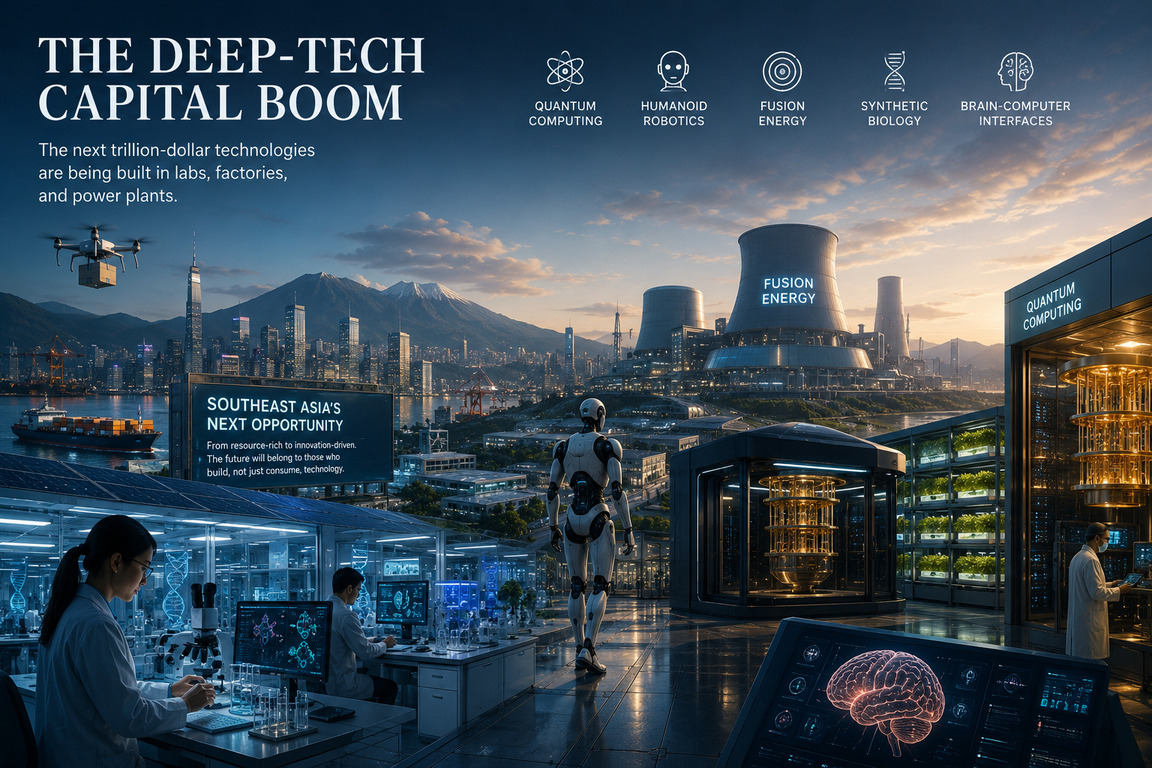
A new investment boom is emerging around technologies once confined to research laboratories and government programs: quantum computing, humanoid robotics, fusion energy, synthetic biology, and brain-computer interfaces. Unlike the software-driven expansion of the 2010s, the current wave is increasingly defined by industrial capability, scientific research, and strategic infrastructure.
In financial markets, the shift is becoming more visible. Venture capital is flowing back into sectors requiring factories, laboratories, power systems, and advanced engineering talent rather than simply scalable software distribution. Governments, sovereign wealth funds, and institutional investors are increasingly treating frontier technologies not merely as innovation assets, but as instruments of economic and geopolitical power.
The scale of capital involved is rising rapidly.
McKinsey estimates that investment into quantum technologies reached approximately US$12.6 billion in 2025, more than six times the level recorded a year earlier, with the overwhelming majority directed toward quantum computing. In robotics, annual venture funding climbed above US$40 billion between 2023 and 2025 as manufacturers accelerated automation programs amid labor shortages and intensifying competition in industrial AI.
Fusion energy, long viewed as commercially distant, is also entering a more serious phase of institutional financing. According to the International Atomic Energy Agency, private investment in fusion companies has surpassed US$10 billion globally. Reuters reported that funding into fusion developers rose roughly 180% in 2025 alone, supported by both state-backed initiatives and growing investor appetite for next-generation energy systems.
The broader implication is becoming increasingly difficult to ignore: deep tech is no longer functioning as a speculative edge case within venture capital. It is evolving into a new industrial investment cycle.
From Software Scale to Industrial Scale

The previous technology era rewarded speed, user growth, and digital distribution. The emerging cycle rewards scientific defensibility, infrastructure ownership, and control over physical systems.
Artificial intelligence is accelerating this transition rather than replacing it. AI models require increasingly vast computational infrastructure, which in turn demands advanced semiconductors, energy-intensive data centers, grid upgrades, cooling technologies, and industrial automation. Frontier science and AI are becoming deeply interconnected.
This convergence is reshaping how investors evaluate technological value creation.
Rather than funding applications layered on top of existing infrastructure, capital is increasingly directed toward the infrastructure itself: compute capacity, robotics systems, bio-manufacturing platforms, advanced materials, and energy technologies.
The International Energy Agency identified more than 150 major energy innovation developments in 2025, spanning areas such as next-generation geothermal systems, sodium-ion batteries, perovskite solar technologies, and fusion energy. Many of these sectors are now benefiting from the same combination of state support, private financing, and geopolitical urgency that previously fueled semiconductor manufacturing.
In effect, the world is entering a phase where scientific capability is becoming industrial strategy. That transition carries profound implications for global capital flows.
The Return of Strategic Industry
One of the defining features of the post-Cold War economy was the assumption that advanced economies would dominate innovation while manufacturing migrated toward lower-cost regions.
Deep tech is reversing part of that logic.
Quantum computing, advanced robotics, synthetic biology, and energy technologies are difficult to outsource purely on the basis of labor costs. They require dense ecosystems of universities, research laboratories, engineering talent, intellectual property protection, and long-term financing.
As geopolitical tensions intensify, governments are increasingly unwilling to leave such capabilities entirely to market forces. The United States, China, and the European Union are all expanding industrial policies linked to semiconductors, energy security, and advanced manufacturing. Frontier technologies are now viewed through the same strategic lens once applied primarily to oil, defense, and telecommunications infrastructure.
This is partly why the next technology cycle looks less like Silicon Valley’s consumer internet boom and more like an industrial modernization race.
The companies attracting the largest valuations today are increasingly those positioned to control physical systems rather than simply digital audiences.
Southeast Asia’s Uneven Position
For Southeast Asia, the rise of deep tech presents both opportunity and risk. The region remains one of the world’s fastest-growing digital markets, supported by a young population, expanding internet penetration, and rising middle-class consumption. Yet much of Southeast Asia’s startup ecosystem remains concentrated in relatively mature digital categories such as fintech, e-commerce, and logistics platforms.
That model generated significant growth during the previous technology cycle. It may prove less competitive in the next one.
According to OECD data, Indonesia’s startup ecosystem remains heavily weighted toward consumer-oriented digital businesses, while investment in frontier engineering and advanced scientific commercialization remains comparatively limited. Startup density in Indonesia also remains below OECD averages despite the country’s large population and expanding digital economy.
The concern is not simply technological competitiveness. It is economic positioning. If the next decade is increasingly driven by energy systems, robotics, advanced manufacturing, and scientific infrastructure, countries without deep R&D ecosystems risk becoming primarily end markets for imported frontier technologies rather than producers of them.
That distinction matters because the economic structure of deep tech differs sharply from software platforms.
Deep-tech industries tend to generate higher-value manufacturing, specialized engineering employment, intellectual property ownership, and strategic supply-chain influence. They also attract longer-duration capital and create stronger industrial spillovers into adjacent sectors.
Countries that fail to build domestic capability may find themselves locked into lower-value segments of the technology economy even as global growth shifts toward industrial science.
Indonesia’s Strategic Window

Indonesia nevertheless holds several structural advantages that could become increasingly relevant in a deep-tech era. The country possesses abundant reserves of critical minerals linked to battery systems, electrification infrastructure, and advanced manufacturing supply chains. It is also emerging as a growing market for data centers and AI infrastructure investment as digital demand expands across Southeast Asia.
Jakarta has recently signaled interest in moving beyond commodity exports toward higher-value participation in technology supply chains, including semiconductors and AI-related infrastructure. The government is also preparing a national AI strategy aimed partly at attracting foreign investment into computational infrastructure.
Whether those ambitions translate into meaningful industrial capability remains uncertain. Building a competitive deep-tech ecosystem requires more than capital inflows alone. It demands sustained investment in research institutions, engineering talent, commercialization pathways, and regulatory frameworks capable of supporting long development cycles.
That challenge is particularly acute in frontier sectors where commercial viability may take years, or even decades, to materialize.
Still, the broader direction of global capital suggests that waiting may carry its own risks. The previous technology boom rewarded countries capable of scaling digital consumption. The next may reward those capable of building scientific and industrial capacity. For Southeast Asia, the question is no longer whether deep tech will matter. It is whether the region intends to participate in shaping the technologies underpinning the next industrial era, or merely import them after the fact.
Read More