





 Sunday, 27-09-26








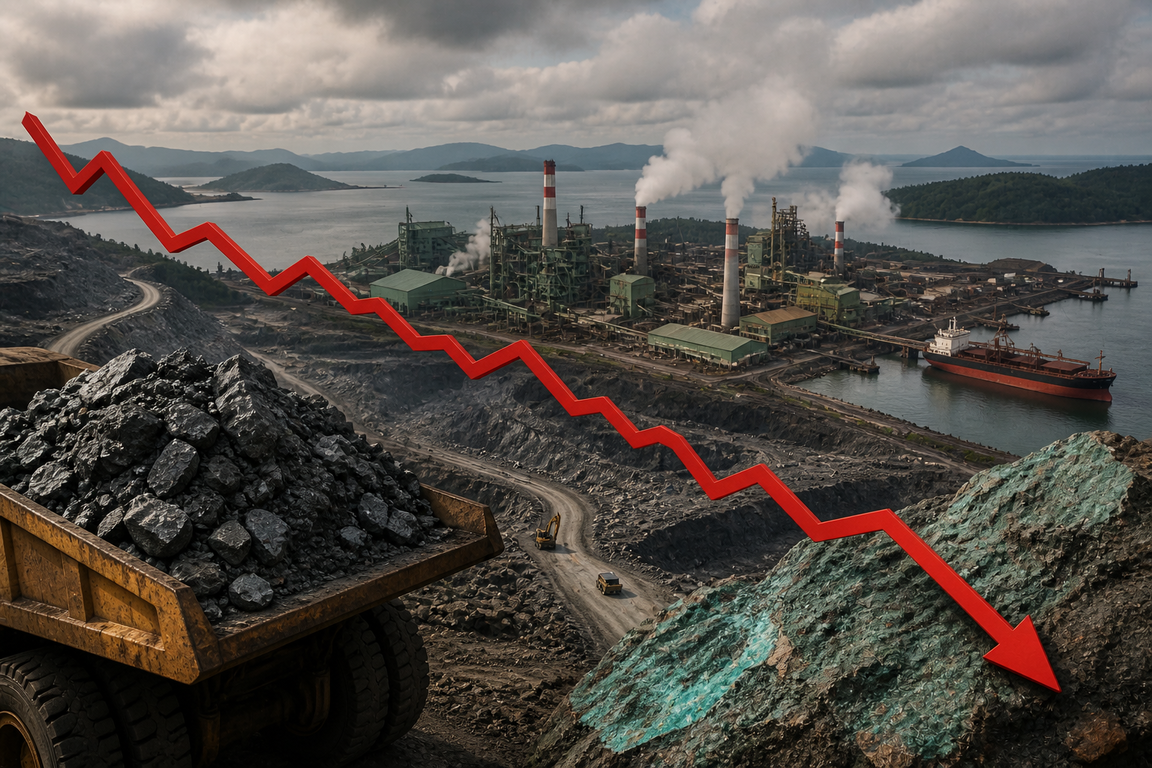
Indonesia’s ambitious plan to dominate the global electric vehicle (EV) supply chain is entering a more complicated phase. After years of aggressive downstreaming policies, massive investment inflows, and rapid smelter expansion, the country now controls more than half of global nickel supply. But in 2026, that success is creating a new problem: structural oversupply that is compressing prices and margins across the value chain. The shift marks a turning point. Indonesia has effectively won the battle for scale, but the economics of that scale are becoming harder to sustain.
From Resource Nationalism to Global Dominance
Indonesia’s nickel strategy has been one of the most aggressive industrial policies in emerging markets. By banning raw ore exports in 2020 and forcing investment into domestic processing, the government triggered a wave of capital inflows, particularly from Chinese firms. According to the United States Geological Survey, Indonesia now accounts for over 50% of global nickel production, up from less than 25% just a few years ago. This transformation has reshaped global supply chains, positioning Indonesia as the centerpiece of the EV battery ecosystem.
The strategy worked, at least initially. The country rapidly built smelting capacity, particularly in nickel pig iron (NPI) and later in battery-grade materials such as mixed hydroxide precipitate (MHP). This enabled Indonesia to move up the value chain and attract major EV and battery investments. However, scale has come at a cost.
Prices Collapse as Supply Floods the Market
Nickel prices have been under sustained pressure since their peak during the 2022 commodity shock. Data from the London Metal Exchange shows that nickel prices have fallen more than 40–50% from their highs, reflecting a sharp imbalance between supply and demand. The key driver is Indonesia’s rapid production growth. The country has added capacity faster than global demand, particularly from EVs, can absorb.
According to a 2026 report by the World Bank, global nickel markets are expected to remain in persistent surplus, with supply growth outpacing demand through the medium term. This is a critical shift: the market is no longer experiencing cyclical oversupply, but a structural glut driven by Indonesia’s scale.
EV Demand Isn’t Catching Up Fast Enough
The oversupply problem is compounded by a mismatch in expectations. Nickel demand is closely tied to EV battery production, particularly for nickel-rich chemistries such as NMC (nickel-manganese-cobalt). But EV adoption, while growing, is not accelerating fast enough to absorb the surge in supply.
Several factors are at play:
- Slower-than-expected EV adoption in some markets
- Rising adoption of LFP (lithium iron phosphate) batteries, which do not use nickel
- Efficiency improvements reducing per-vehicle nickel intensity
These trends are dampening demand growth at precisely the moment when supply is surging. The result is a widening gap between production and consumption, a classic setup for prolonged price weakness.
Chinese Dominance Intensifies Competition
Another critical factor shaping the market is the dominance of Chinese-backed producers in Indonesia’s nickel industry. Chinese companies have played a central role in financing and building smelters, bringing cost efficiencies and rapid execution capabilities.
But this has also intensified competition. Chinese firms operate with:
- Lower cost structures
- Integrated supply chains
- Strong government backing
This makes it difficult for higher-cost producers, both within Indonesia and globally, to compete.
Recent reporting by Reuters highlights that several global mining companies have cut production, delayed projects, or exited the nickel market altogether due to falling prices and weak margins. This is a clear signal: the market is undergoing consolidation.
Margin Compression Across the Value Chain
The impact of falling prices is being felt across the nickel ecosystem.
1. Smelters
Smelters face shrinking margins as input costs remain relatively stable while output prices decline. Newer, more efficient plants may still be profitable, but older or higher-cost facilities are under pressure.
2. Battery Supply Chain
Battery manufacturers benefit from lower input costs, but volatility creates uncertainty in long-term planning and investment decisions.
3. Mining Companies
Upstream producers are the most exposed. Lower prices directly reduce revenue, forcing companies to reassess expansion plans and capital expenditure. The broader implication is a shift from growth-at-all-costs to profitability discipline.
Strategic Tension: Volume vs Price Stability
Indonesia now faces a strategic dilemma. Its success in expanding production has given it unmatched influence over global supply, but that same expansion is depressing prices.
This creates a tension between:
- Maximizing output to maintain market share
- Managing supply to stabilize prices
Unlike oil markets, where organizations like OPEC coordinate production cuts, the nickel market lacks a similar mechanism. Indonesia could theoretically play a stabilizing role, but doing so would require coordination with private and foreign-owned producers, a complex political and economic challenge.
Global Ripple Effects
Indonesia’s nickel oversupply is not just a domestic issue, it is reshaping global markets.
- Western mining companies are scaling back investments
- Battery manufacturers are benefiting from lower costs
- EV producers may see improved margins over time
At the same time, the concentration of supply in one country raises concerns about supply chain resilience and geopolitical risk.
Governments in the US and Europe are increasingly focused on diversifying critical mineral supply chains, which could influence future investment flows.
What Comes Next
The key question for 2026 and beyond is whether the market can rebalance. There are several possible scenarios:
- Demand catches upFaster EV adoption absorbs excess supply
- Supply slows downProjects are delayed or canceled
- Structural oversupply persistsPrices remain low for an extended period
Current data suggests the third scenario is the most likely in the near term. The World Bank has indicated that commodity markets, including nickel, may face prolonged price pressure due to supply-side expansion, reinforcing the view that this is not a short-term correction.
Winning the Supply War Isn’t Enough
Indonesia’s nickel strategy has fundamentally reshaped the global market. It has successfully moved the country up the value chain, attracted billions in investment, and positioned it as a critical player in the EV transition. But in 2026, the next phase is about economics, not scale.
Oversupply, falling prices, and intensifying competition are forcing a recalibration of the strategy. The focus is shifting from expansion to efficiency, from growth to profitability. Indonesia may have won the race to dominate global nickel supply. But the real challenge now is winning the pricing game.
Read More