





 Friday, 02-10-26








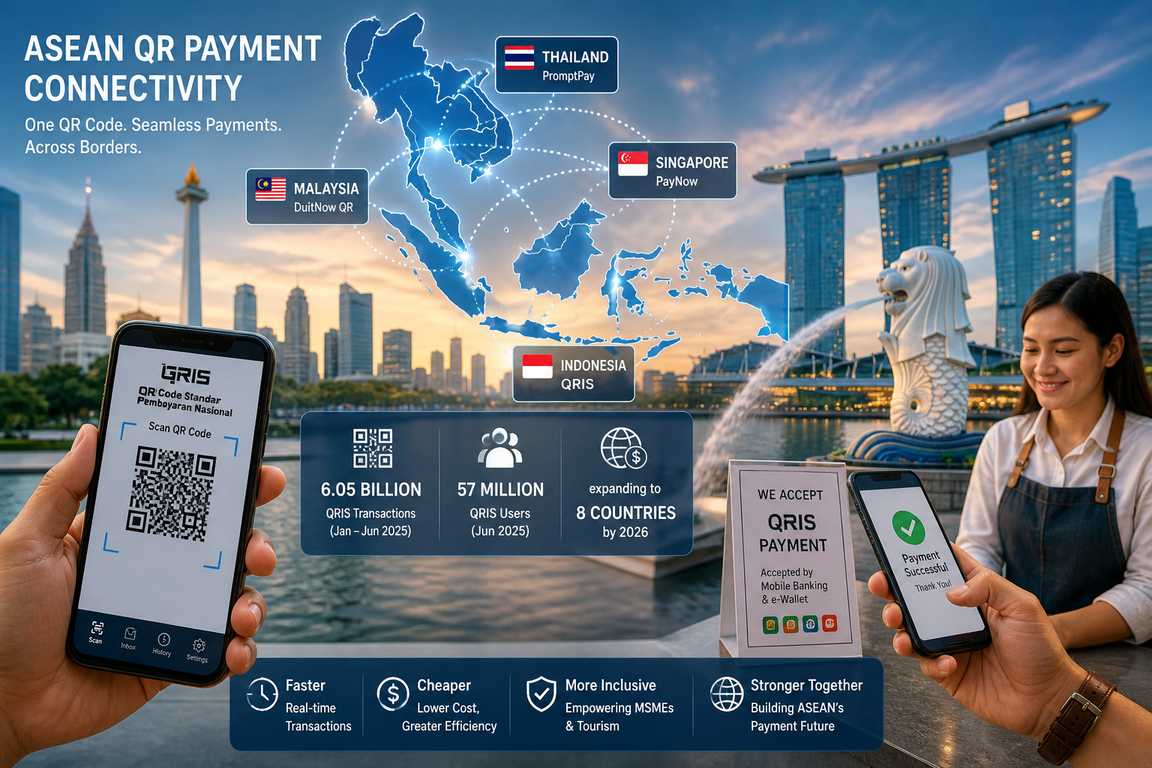
Southeast Asia is entering a new phase of financial integration, one that is increasingly defined not by banks or global card networks, but by interoperable QR payment systems. What began as a domestic push for cashless transactions has evolved into a regional infrastructure race, where central banks are linking payment systems across borders to enable real-time, low-cost transactions in local currencies.
In 2026, this shift is accelerating rapidly. Indonesia has expanded its national QR system, QRIS, beyond ASEAN into major markets like China, marking a significant step toward a broader Asian payment network. The implications are structural: Southeast Asia is not just digitizing payments, it is building an alternative financial rail.
From Domestic QR Systems to Regional Infrastructure
The foundation of this transformation lies in the integration of national QR systems such as QRIS (Indonesia), PromptPay (Thailand), DuitNow (Malaysia), and PayNow (Singapore). These systems are now interconnected under ASEAN’s broader push for payment connectivity and local currency settlement. According to the International Monetary Fund, ASEAN countries have established multiple bilateral cross-border payment linkages to reduce costs and enable real-time transactions, forming the backbone of a regional payment ecosystem.
This integration is not accidental. It is part of a deliberate policy agenda to reduce inefficiencies in cross-border payments, which remain significantly more expensive and slower than domestic transactions. By connecting national systems, ASEAN is effectively creating a distributed, interoperable payment network, without relying on a single centralized platform. Indonesia’s QRIS illustrates the scale of this transformation. By mid-2025, the system had reached 57 million users and 39.3 million merchants, processing 6.05 billion transactions worth IDR 579 trillion (US$37 billion) in just six months.
This domestic scale is critical. Cross-border systems only become viable when the underlying local infrastructure is already deeply embedded in everyday commerce.
2026 Expansion: From ASEAN to Asia
The most important development in 2026 is geographic expansion. Indonesia is no longer limiting QRIS to ASEAN corridors. In April 2026, Bank Indonesia officially launched cross-border QR payments with China, allowing users from both countries to transact simply by scanning QR codes. The system integrates with major Chinese payment platforms such as Alipay and UnionPay QR, with further expansion to WeChat Pay under development. This marks a critical shift: ASEAN’s QR ecosystem is beginning to connect with larger Asian financial systems, extending its relevance beyond regional tourism.
At the same time, Bank Indonesia is targeting expansion to up to eight countries by 2026, including South Korea and India, as part of a broader push to enable local currency transactions and reduce reliance on foreign exchange intermediaries. This aligns with the ASEAN Integrated QR Payment initiative, which aims to reduce dependence on the US dollar by enabling direct currency exchange between participating countries. In practical terms, this means a Thai tourist in Indonesia can pay in baht, while the merchant receives rupiah, without passing through dollar-based settlement systems.
A Shift Away From Traditional Payment Rails
The strategic significance of this development lies in its potential to reshape the global payment hierarchy. Traditional cross-border payments rely heavily on card networks and correspondent banking systems, which introduce multiple intermediaries, fees, and delays. QR-based systems bypass much of that complexity. Transactions are executed through direct connections between national payment infrastructures, reducing costs and settlement time. For small-value retail transactions, such as food, transport, and tourism spending, this model is significantly more efficient.
A 2026 academic study highlights that QRIS and similar systems function as instruments of economic statecraft, reducing dependency on global payment networks like Visa and Mastercard while strengthening domestic control over financial data and transaction flows. This is where the “QR payment war” becomes more than a fintech story. It is about who controls the rails of money movement.
Real Economic Impact: MSMEs and Tourism
The most immediate beneficiaries of cross-border QR payments are micro, small, and medium-sized enterprises (MSMEs), which dominate Southeast Asia’s economic landscape. In Indonesia alone, there are over 65 million MSMEs, many of which operate in informal sectors and lack access to traditional payment infrastructure. QR systems allow these businesses to accept digital payments using nothing more than a printed QR code.
Cross-border functionality amplifies this impact. Tourists can pay directly using their home-country apps, eliminating the need for cash exchange or international card acceptance. This reduces friction and increases spending efficiency. Tourism is a key driver. Indonesia recorded 15.39 million international visitors in 2025, generating approximately US$18.9 billion in foreign exchange earnings. As QR interoperability expands, a larger share of that spending can flow seamlessly into local businesses, improving liquidity and reducing transaction leakage.
The Rise of Local Currency Transactions
Another critical dimension is the shift toward local currency settlement (LCT). ASEAN’s QR payment integration is closely tied to efforts to reduce reliance on the US dollar in regional trade. Under this framework, transactions are settled directly between participating currencies, improving efficiency and reducing exposure to exchange rate volatility. This is particularly important for emerging markets, where currency fluctuations can significantly impact transaction costs.
The ASEAN QR system is part of a broader movement toward financial sovereignty, where countries seek greater control over their payment systems and data flows.
Challenges: Fragmentation and Security Risks
Despite its momentum, the system faces several challenges. Interoperability across multiple jurisdictions requires coordination on technical standards, regulatory frameworks, and cybersecurity protocols.
As transaction volumes increase, so does the risk of fraud and system vulnerabilities. ASEAN policymakers have already identified the need to strengthen oversight and security infrastructure as a priority. There is also the risk of fragmentation. As more countries develop their own payment systems and link them selectively, the global payment landscape could become increasingly fragmented, complicating interoperability at a broader scale.
A New Financial Layer Is Emerging
Southeast Asia’s QR payment ecosystem is no longer a convenience feature, it is becoming a core layer of regional financial infrastructure.
By combining:
- Interoperable national systems
- Local currency settlement
- Government-led coordination
ASEAN is building a payment network that is faster, cheaper, and more inclusive than traditional alternatives. The expansion into China and other major markets in 2026 signals the next phase: scaling beyond ASEAN into a broader Asian payment architecture.
The strategic implication is clear. The future of cross-border payments may not be dominated by global card networks, but by interconnected national systems, each anchored in domestic sovereignty yet linked through regional cooperation. In that future, the most powerful financial network may not be the one with the biggest brand, but the one with the most connections.
Read More