





 Friday, 19-06-26








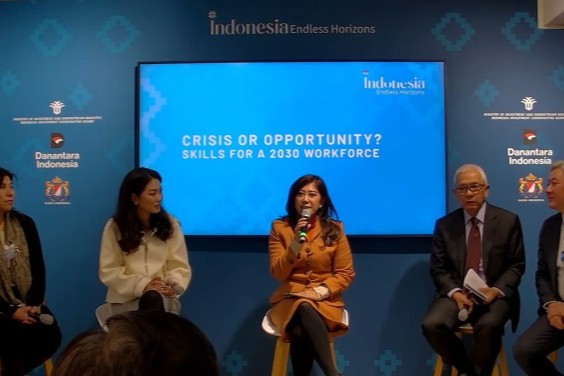
Indonesia’s Minister of Communication and Digital Affairs, Meutya Hafid, warned that digital transformation and global technological progress do not automatically benefit everyone and could widen social inequality without inclusive skills policies, speaking at the World Economic Forum (WEF) 2026 in Davos, Switzerland (20/01).
She delivered the statement during the session “Crisis or Opportunity? Skills for a 2030 Workforce” at the Indonesia Pavilion, emphasizing the social risks of unequal access to skill development.
Skills Gap Seen as Main Challenge in the Future of Work
According to Meutya, the most pressing issue in today’s labor market is not the disappearance of jobs but the growing gap between workers’ skills and future economic needs.
“Jobs are not truly disappearing. What is changing are the skills. If countries fail to prepare their citizens equally, technological transformation will leave many people behind,” Meutya said.
She referred to the Future of Jobs Report by the World Economic Forum, which projects around 170 million new jobs globally by 2030, while approximately 92 million existing roles are expected to be displaced.
Indonesia’s Digital Potential Relies on Inclusive Skill Development
Meutya noted that Indonesia, as a large democracy with more than 230 million internet users and a predominantly young population, has strong potential to benefit from digital transformation.
However, she stressed that this potential can only be realized if skills investment reaches all layers of society.
“Young people, women, informal sector workers, and groups with limited access must be part of the national skills agenda. Inclusion is not an addition, but a core requirement for digital transformation to deliver social justice,” she said.
Government Prioritizes Digital Skills and Lifelong Learning
The minister explained that the Indonesian government is prioritizing digital skills development, lifelong learning, and adaptive policies to respond to technological change.
These efforts aim to ensure that technological progress supports social mobility and strengthens national competitiveness rather than creating new gaps in society.
“Digital skills must go hand in hand with human capabilities such as critical thinking, adaptability, and collaboration. That is where the future of work will be determined,” Meutya said.
WEF Discussion Highlights Importance of Collaboration
Meutya stated that the current decade will be a decisive period for Indonesia’s human resource development.
“Policy choices made today will determine whether digital transformation becomes a shared path to progress or instead widens inequality. Indonesia chooses to prepare all its citizens to face change,” she said.
The discussion also featured AI Academy Asia Founder and CEO Bolor Erdene Battsengel and Teach For All CEO and Co-Founder Wendy Kopp, highlighting the importance of collaboration between government, business, and the education sector to build an inclusive and relevant skills ecosystem.
PHOTO: MINISTRY OF COMMUNICATION AND DIGITAL AFFAIRS
This article was created with AI assistance.
We make every effort to ensure the accuracy of our content, some information may be incorrect or outdated. Please let us know of any corrections at [email protected].
Read More