





 Thursday, 18-06-26








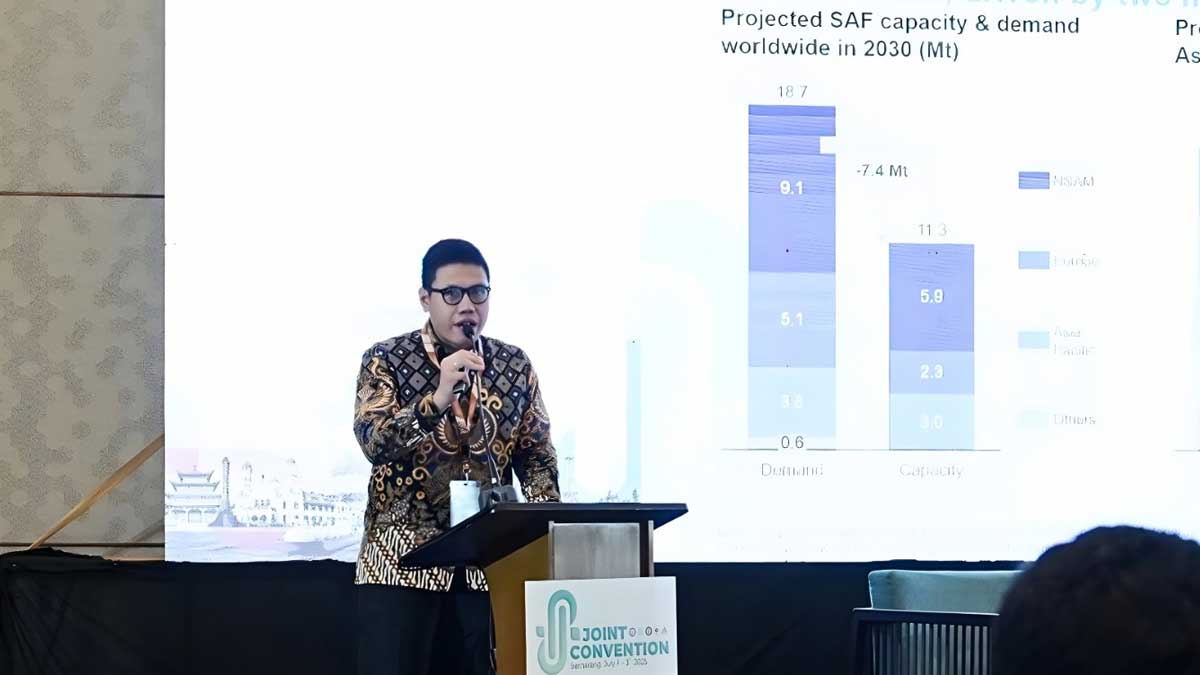
Indonesia is taking a decisive step in the global race to decarbonize aviation through the development of POME based sustainable aviation fuel. As pressure mounts on the aviation industry to cut carbon emissions, Indonesia is leveraging one of its most abundant resources, palm oil mill effluent or POME, to position itself as a future hub for sustainable aviation fuel production. The involvement of PT Tripatra Engineering in international validation processes underscores the country’s ambition to align industrial innovation with global sustainability frameworks.
The aviation sector currently contributes around 3 percent of global carbon dioxide emissions, according to industry estimates. With air traffic expected to continue growing over the coming decades, the need for scalable and credible low carbon solutions has become urgent. Sustainable aviation fuel has emerged as one of the most realistic options because it can be used directly in existing aircraft engines without requiring major infrastructure changes. In this context, POME based sustainable aviation fuel offers Indonesia a competitive advantage, combining environmental performance with economic potential.
Indonesia’s Strategic Role In POME Based Sustainable Aviation Fuel Development
Indonesia is the world’s largest palm oil producer, generating millions of tonnes of by products annually. Among these, palm oil mill effluent has traditionally been viewed as industrial waste with significant environmental risks, particularly methane emissions. By transforming POME into a feedstock for aviation fuel, Indonesia is converting an environmental liability into a strategic asset.
Tripatra’s participation in the ICAO CAEP Global Study on Life Cycle Assessment for POME HEFA is a critical milestone. Through a rigorous technical process spanning more than a year, POME was evaluated as a residue feedstock that does not carry indirect land use change burdens. This distinction is crucial in global sustainability standards, where land use concerns often limit the eligibility of biofuels derived from agricultural sources.
The recognition of POME based sustainable aviation fuel in the ICAO CORSIA Default Life Cycle Emissions Values represents formal international acceptance. This approval allows SAF producers worldwide to apply a default emission value when using POME as feedstock, significantly reducing regulatory uncertainty and accelerating market adoption.
Life Cycle Assessment Results And Emission Reduction Impact
One of the most critical aspects of sustainable aviation fuel eligibility is its life cycle emissions profile. The life cycle assessment conducted for POME HEFA demonstrated a carbon intensity of 18.1 gCO2e per megajoule. This figure is substantially lower than conventional jet fuel, confirming the strong environmental performance of POME based sustainable aviation fuel.
Independent verification by international academic and research institutions further strengthened the credibility of the findings. By benchmarking the results against studies from European universities and technical validation from recognized research bodies, the assessment met ICAO’s stringent scientific standards.
This emission profile enables potential savings of up to 80 percent compared to fossil based aviation fuels. For airlines operating under the CORSIA scheme, this translates into reduced offsetting requirements and lower compliance costs. For Indonesia, it establishes a clear value proposition in the global SAF supply chain.
Circular Economy And Industrial Value Creation
Beyond emissions reduction, POME based sustainable aviation fuel exemplifies the principles of a circular economy. Instead of treating palm oil mill effluent as waste, the process captures its residual energy value and converts it into a high value fuel product. This approach delivers multiple benefits across the value chain.
First, it mitigates methane emissions that would otherwise be released during waste treatment. Methane is a potent greenhouse gas, and its reduction significantly improves the overall environmental footprint of the palm oil industry. Second, it creates additional revenue streams for palm oil producers, enhancing the economic sustainability of the sector.
Tripatra’s role as a technology developer and integrator positions the company as a catalyst for cross sector collaboration. By connecting upstream palm oil operations with downstream aviation fuel markets, the company supports the formation of a domestic SAF ecosystem that can scale over time.
Alignment With Global Aviation Decarbonization Efforts
The development of POME based sustainable aviation fuel aligns closely with international aviation climate targets. The International Civil Aviation Organization has committed to achieving net zero carbon emissions from international aviation by 2050. CORSIA serves as a transitional mechanism to stabilize emissions while cleaner technologies mature.
Sustainable aviation fuel plays a central role in this strategy because it is currently the only solution capable of delivering large scale emission reductions without disrupting aviation operations. Unlike hydrogen or electric aircraft, which remain in early development stages, SAF can be deployed immediately using existing fleets.
Indonesia’s contribution through POME strengthens global supply diversity. Most SAF production today is concentrated in North America and Europe, often relying on used cooking oil or animal fats. Expanding feedstock options through residues like POME reduces competition for limited resources and supports long term scalability.
National Energy Transition And Policy Implications
For Indonesia, POME based sustainable aviation fuel supports broader national objectives related to energy security and industrial competitiveness. The country has long pursued policies to reduce dependence on imported fossil fuels while maximizing domestic renewable resources. SAF development fits squarely within this agenda.
Government support, particularly from the Ministry of Transportation and Ministry of Foreign Affairs, highlights the strategic importance of securing international recognition. By successfully submitting a default life cycle assessment value to ICAO, Indonesia has ensured that its feedstock is not disadvantaged in global markets.
This achievement also sends a strong signal to investors. Regulatory clarity and international acceptance reduce project risk, making it easier to mobilize capital for SAF facilities, supporting infrastructure, and technology development.
Industry Readiness And Long Term Outlook
While recognition is a major milestone, scaling POME based sustainable aviation fuel production will require coordinated efforts across multiple sectors. Feedstock collection systems, processing infrastructure, financing mechanisms, and offtake agreements with airlines must all be developed in parallel.
Tripatra’s experience in large scale energy projects positions it well to support this transition. With more than five decades of expertise, the company has the technical and project management capabilities required to bridge early stage development and commercial deployment.
The long term outlook for SAF demand is strong. Airlines face increasing pressure from regulators, investors, and consumers to demonstrate credible decarbonization pathways. As CORSIA obligations expand and voluntary climate commitments grow, demand for low carbon aviation fuels is expected to rise steadily.
Challenges And Risk Considerations
Despite its promise, POME based sustainable aviation fuel also faces challenges. Feedstock logistics must be carefully managed to ensure consistent supply without disrupting existing palm oil operations. Environmental safeguards are essential to maintain credibility, particularly in global markets sensitive to sustainability claims.
Technology deployment must also be optimized to ensure cost competitiveness. While SAF currently carries a price premium over fossil jet fuel, economies of scale and supportive policy frameworks can narrow this gap over time.
International competition is another factor. As more countries develop SAF strategies, Indonesia will need to continue demonstrating reliability, sustainability, and policy consistency to secure long term market share.
Conclusion
The recognition of POME based sustainable aviation fuel by the International Civil Aviation Organization marks a significant breakthrough for Indonesia’s renewable energy ambitions. By transforming palm oil mill effluent into a globally accepted aviation fuel feedstock, Indonesia has combined environmental responsibility with industrial opportunity.
Tripatra’s involvement highlights the importance of private sector expertise in navigating complex international processes and delivering credible technical outcomes. As the global aviation industry accelerates its transition toward lower emissions, Indonesia’s POME based SAF pathway offers a compelling model of how emerging economies can lead through innovation, collaboration, and resource optimization.
With strong government backing, international recognition, and growing market demand, POME based sustainable aviation fuel has the potential to become a cornerstone of Indonesia’s energy transition and a meaningful contributor to global aviation decarbonization efforts.
Read More