





 Tuesday, 30-06-26








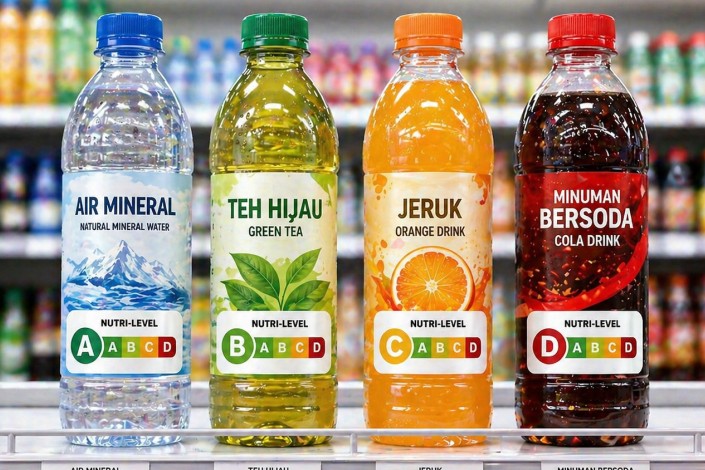
The Indonesian government has issued a new regulation introducing Nutri-Level labeling for ready-to-eat and ready-to-drink food products, especially sugary beverages. The policy is established under the Minister of Health Decree KMK No. HK.01.07/MENKES/301/2026.
The regulation is issued by the Kementerian Kesehatan Republik Indonesia as part of efforts to encourage healthier consumption patterns among the public.
According to Health Minister Budi Gunadi Sadikin, the policy aims to reduce excessive intake of sugar, salt, and fat, which are linked to non-communicable diseases such as diabetes, hypertension, stroke, cardiovascular disease, and kidney failure.
The policy applies to large-scale food and beverage businesses, while small and micro enterprises such as traditional stalls and small restaurants are excluded in the initial phase.
Nutri-Level Uses Color-Coded System to Classify Sugar, Salt, and Fat Content
The Nutri-Level system categorizes products into four levels: A (dark green), B (light green), C (yellow), and D (red). Each level reflects the amount of sugar, salt, and saturated fat per 100 ml of product.
Level A represents the lowest content of sugar, salt, and fat, while Level D represents the highest. The system is designed to simplify nutritional information into a clear visual format for consumers.
Level A does not allow the use of added sweeteners. Level B allows only natural sweeteners. Meanwhile, Levels C and D may use both natural and artificial sweeteners.
The labeling must be displayed on menus, packaging, brochures, advertisements, and digital platforms to ensure visibility across multiple consumer touchpoints.
Rising Health Costs Highlight Urgency Behind Policy Implementation
The regulation is introduced in response to increasing health and financial burdens caused by non-communicable diseases.
Data from the Ministry of Health shows that kidney failure treatment costs rose significantly from IDR 2.32 trillion in 2019 to IDR 13.38 trillion in 2025, an increase of more than 400%.
The government also estimates that diabetes could affect up to 28.6 million Indonesians by 2045 if preventive actions are not strengthened.
These conditions have increased pressure on national healthcare spending and highlight the need for preventive health policies.
Critics Question Effectiveness and Clarity of Nutri-Level Policy
The Nutri-Level regulation has received criticism from consumer advocacy groups.
The Consumer Empowerment Forum of Indonesia (FKBI), represented by chairman Tulus Abadi, stated that the policy appears “compromised and ambiguous.”
Forum Konsumen Berdaya Indonesia argues that the labeling design is too small and lacks strong visibility, making it less effective for influencing consumer behavior.
The organization also stated that the policy may reflect industry pressure and could be less effective in reducing degenerative diseases such as diabetes, heart disease, and cancer.
FKBI suggested that the policy should be temporary and strengthened within two years with more robust measures.
Indonesia Plans Sugar Tax Under Health Regulation Framework
In addition to Nutri-Level labeling, Indonesia is preparing an excise tax on sugar-sweetened beverages under Government Regulation PP 28/2024 on Health.
The tax targets products such as soft drinks, bubble tea, energy drinks, and other sweetened beverages. Proposed rates include IDR 1,500 per liter for ready-to-drink products and IDR 2,500 per liter for concentrated beverages. A 2.5% per-unit tax model has also been discussed in parliament.
WHO Highlights Global Need for Stronger Sugar and Alcohol Tax Policies
The World Health Organization (WHO) reports that at least 116 countries have implemented taxes on sugar-sweetened beverages, but most remain too low to significantly reduce consumption.
WHO Director-General Tedros Adhanom Ghebreyesus stated that in many countries, taxes are too low, poorly designed, and not adjusted for inflation, making unhealthy products increasingly affordable.
WHO economist Anne-Marie Perucic noted that average taxes on sugary drinks are around 9%, with soda taxes averaging only about 2.4% per can.
WHO Assistant Director-General Jeremy Farrar stated that health taxes can reduce consumption and help prevent non-communicable diseases while also generating government revenue.
Evidence from countries such as the United Kingdom and Lithuania shows that stronger taxation policies have led to reduced consumption and improved health outcomes.
This article is a summary of several original articles. The full versions can be read at the following links:
https://kemkes.go.id/id/kemenkes-terbitkan-aturan-untuk-cegah-konsumsi-gula-berlebih
https://jdih.kemkes.go.id/documents/keputusan-menteri-kesehatan-nomor-hk0107menkes3012026
https://rri.co.id/bogor/sudut-pandang/2385216/fkbi-kebijakan-nutri-level-terkesan-kompromis-ambigu
https://www.cekindo.com/blog/sugary-drink-tax
PHOTO: UPNEWS.ID
This article was created with AI assistance.
We make every effort to ensure the accuracy of our content, some information may be incorrect or outdated. Please let us know of any corrections at [email protected].
Read More